
Short Story
Hummingbird
by Rachel Huh
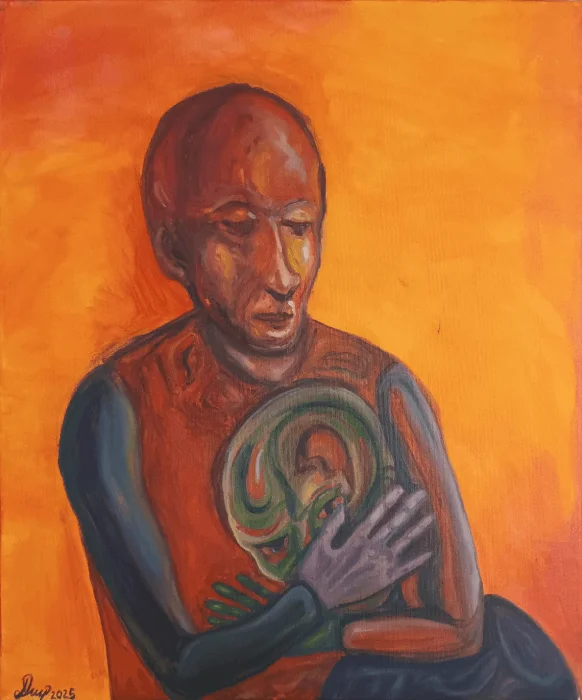
Before
She recites the story of how I became hers.
I was in the middle of cooking, she tells me in Korean as she taps out a beat on the steering wheel. The car turns into the parking lot. Kimchi jiggae, that’s what she made my dad for dinner when she realized she was going into labour. After preparing his meal, she mopped amniotic fluid off the kitchen floor before taking a taxi to the hospital. She brought a towel, she assures me.
I laugh with her, show her I understand, though I hesitate to respond. Mine is a poor mimic of my mother’s tongue.
My mother is a hummingbird. Always has been — small and whirring as she zips in all directions. The laws of physics are not so steadfast as she.
In the passenger’s seat, I try to smile, hiding how dizzy the small turn of her car makes me, how cold I am despite the summer sun. A shiver runs down my spine. This is the first time we’re seeing each other in weeks. Like my mother, I puzzle tasks and to-dos too readily into the empty spaces of breathless days. The habit robs us of each other but connects us too. I wonder why we don’t try to see each other more.
The nurses were mad, she continues in Korean, maneuvering the SUV towards a narrow spot just outside the restaurant doors. There was so much fussing. Very dramatic, she continues.
I could smell the pinch of antiseptic, hear how her teeth creaked louder than her burdened breath. I imagine her dry-eyed and determined, recreating the mythic memory from the story recited to me my whole life. The room bustled with people, beeps from machines and monitors accompanying their harried steps. Dabbing her sweat-jeweled brow, the nurses tried to coax a cry from her, assured her that catharsis is worth the humiliation. But my mother’s teeth were sharp, guillotining screams before they could sound a cry. Bracing and quiet, she shaped herself around me. The first scream in that hospital room was mine.
I’ve never heard a cry so loud, she finishes as she unbuckles her seatbelt.
Doing the same, I twist back for my crutches laying in the backseat. I can’t reach them, but my mother is already out the door before I can ask for her help. Ache pries my joints wide as I try again. I sprained my ankle a few weeks ago — the third time this year. It’s unbelievable, my mother once told me, the sprains, dislocations, fevers, and joint pain, the eagerness with which my body falls apart. The doctors agree with her, there is nothing wrong with me. No virus, no bacterial infection, no deficiencies but my own.
I reach for the backdoor. She stops me.
You don’t need those.
I hop on one leg, the other aloft and unmarked by injury, but for the slight swelling and a fading bruise.
What?
Everyone will worry. Let’s go inside.
Her friends and their children wait for us inside the restaurant, but my mother shows no signs of hurrying. I can already hear the barrage of questions being asked, the offers to help, the unsolicited advice that my mother is trying to avoid. I would not need my crutches were I more like her. I’m too afraid to ask her whether she agrees. We both know she prefers the taste of bleeding words restrained by gritted teeth.
I walk ahead of her to the restaurant, my crutches kept behind closed doors.
After
My mother slips into my apartment.
Taking in my tangle of sheets — or perhaps just the smell — she stops in my bedroom doorway. It’s rare, seeing her still, my hummingbird mother. Her voice is quiet, her words both factual and wishful, worried and nagging.
You’d feel better if you got out more.
Have you eaten today? You’re making yourself sick.
Being in the dark all the time isn’t good for you.
Before I can respond, she flicks the light on. Plucking the wrappers I’ve abandoned on my kitchen counter, clearing away the glasses I’ve collected on my bedside table, shoring up the detritus that covers my apartment, she is in motion again.
Because I am Korean, being ill is a privilege — a condition one earns through age. And when one is sick, the hummingbird women zip into motion, preparing food; organizing rotations of check-ins; volunteering as administrators and chauffeurs. My mother and her friends, all divorcees or begrudging wives, have been sisters in service countless times over. But sickness is a secret when you aren’t over 60. The brigade of mothers, the ahjummas, are not deployed for my care. I am embarrassed at the thought. At 27, illness is selfish, too old to be abandoning my filial duty and too young to be causing my mother such worry.
Her hands are warm and papery on the back of my neck as she tilts a glass of cool water to my burning lips. My mother holds me like I’m fragile, like my carved-out bones are as hollow as they feel. But I am no hummingbird.
She is moving through the kitchen until her hands alight on my ankle, the only part of me exposed from my duvet-built bunker. After repeated failed attempts, she gives up only for guilt to prod me out of bed. She helps me up to cross from my bedroom to my kitchen, to sit down. I feel her gaze on my unwashed hair, my shrivelled body.
I’m sorry it’s not better, she says about the kimchi jiggae — my favourite. She laments the lack of spice in peppers bought anywhere but H-Mart. Sometimes A-Mart when there is a good deal, she amends. She lists all the Korean ingredients I lack. Sesame seed oil. The good soy sauce. Red pepper flakes — I only have the white-people pepper flakes. She adds picking some up for me to her list of errands. I don’t tell her that I haven’t been able to stand in my kitchen to cook in months, that I don’t trust my shaky hands with a knife.
It’s fine, I croak, sharper than I meant to. Pausing to rest my trembling hands between bites of rice and soaked pork, I lay them on my lap, under the table, out of sight.
You need to stop forgetting to eat.
I’m not forgetting, I want to say. Lying down is just more urgent.
For a while, she watches me eat, eyes trailing the way my jaw is slow to hinge open, how I grimace with each swallow. If she studies me hard enough, she is sure that she can find something to scrutinize into functioning.
Ginger. Acupuncture. Dates. Ginger and dates boiled into inedible tea. Equally inedible herbal concoctions that taste like mud and home. Getting out more. Eating better. Turning on the lights. She can love me enough to cure me; she is sure of it. I don’t tell her [redacted] is a genetic disorder.
I can’t bring myself to consider that perhaps she is sick too; that being fine is a choice I’m abdicating in my weakness.
When she tells me she’s brought me more ginger tea, I laugh. I don’t know how to cry without hurting her. I will teach myself to choke it down when I’m alone again. I stop when her gaze catches on my chopsticks faltering between my fingers. I clatter them onto the table. It hurts her, she tells me, to see me so sick.
But I don’t know how to make her look away. To ask her to stay. To beg her to stop. To help. I can only think to apologize. I’m sorry for worrying you. I’m sorry for not getting better. For not trying harder.
Umma. My voice breaks around the word, one of the few I’ve harboured from childhood. A plea. A question. An answer. Mom. I sense her, my hummingbird mother, flying about my rib cage. She moves every which way but out.
So, I offer the only kindness I know how. I ask her to leave. I tell myself that we’ll be better when I am.
The End.
Appeared in Issue Fall '26
Comments on "Hummingbird"
Please log in to submit a comment.
Login