
Published July 26th, 2026
Review
Surviving and Community on the Fringes of Society — A Review of “The Emperor of Gladness” by Ocean Vuong
by Luka Peters
In The Emperor of Gladness (Penguin Press, 2025), Ocean Vuong returns to Connecticut’s working class and immigrant community. He invites us to witness the hard life of a group of people who search and fight for dignity and self-determination. They navigate the margins of society with compassion, boldness, and tenderness, searching for their share of the American dream.
***
What is gladness? Does it fill your heart to the brim, lighting your way throughout the day?
In Ocean Vuong’s novel The Emperor of Gladness, it is the opposite: a rundown neighbourhood in Connecticut. It is also the canvas on which Vuong paints a picture of society. However, he doesn’t use a pointed pencil or sharp contours. As with a hazy watercolour or a blurred photograph, details are revealed slowly. Like fog, a certain sadness persists throughout the entire narrative. However, it is not a sad story. Vuong uses affection and witty humour to guide us through the muddy streets of East Gladness alongside Hai, the 19-year-old “in the midnight of his childhood and a lifetime from his first light” (p. 7) who is about to jump from a bridge. Grazina, an old Lithuanian woman, prevents him from taking the final step and offers him a multitude of new perspectives. There is no Harold and Maude story following. Instead, we witness connection, kindness, and support. Grazina, who suffers from dementia, and Hai are both struggling to survive and maintain dignity. Together they create a space in which to take care of each other.
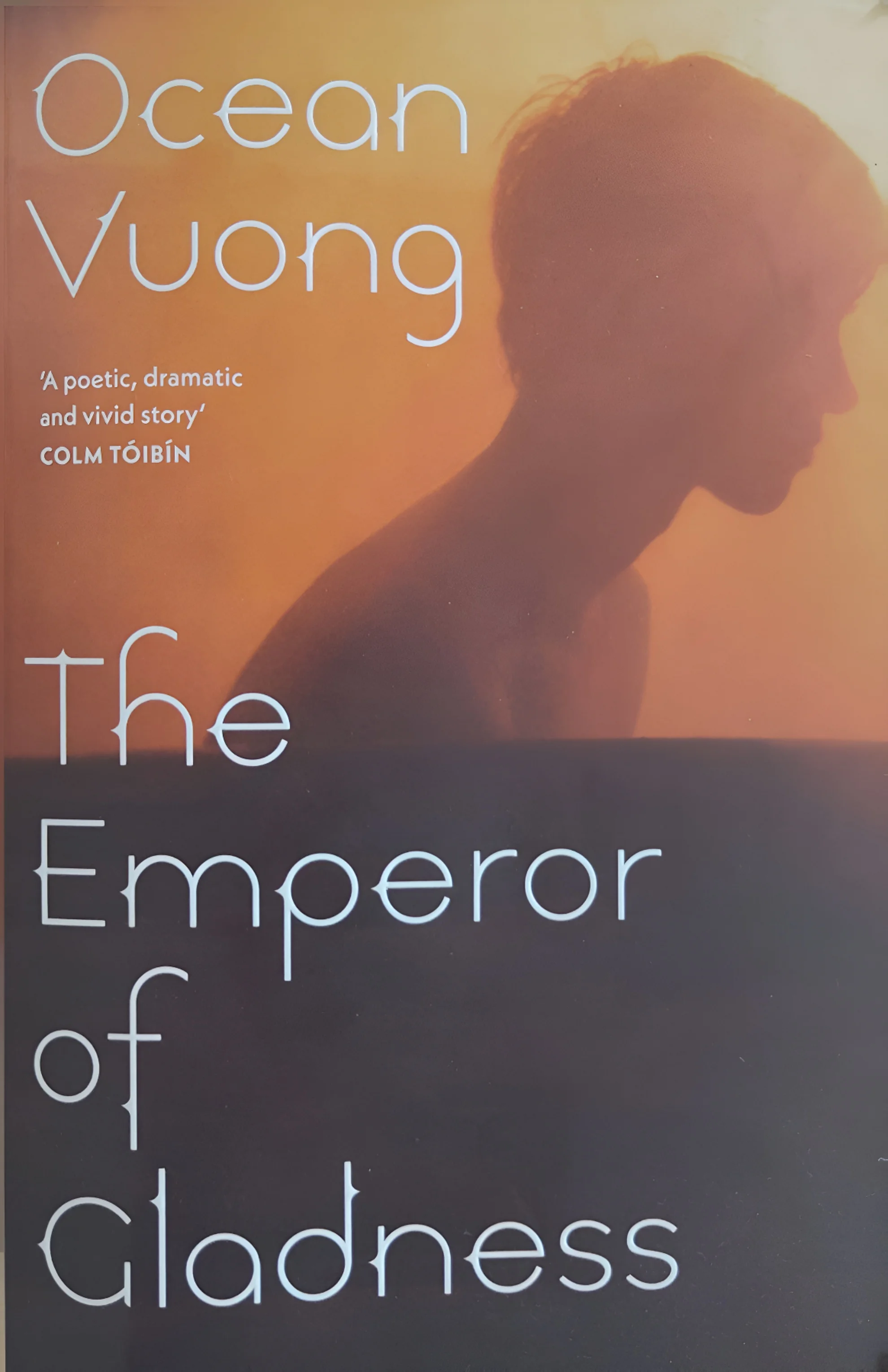
Set in 2009, Vuong returns to the issues raised in his previous novel, On Earth We’re Briefly Gorgeous (Penguin Press, 2019): poverty, the opioid crisis, the immigrant working class, and queerness. I admit that this novel challenged me in two ways: Firstly, Vuong creates a unique language that is both highly lyrical and tender, and harsh and full of slang expressions from the working classes and drug scenes. The second challenge lies in the book’s richness of thematic layers. The author demonstrates the interconnected nature of race, age, class, gender and identity.
So, here we are in the Obama era. Election posters bearing the slogan “Yes We Can” are decaying much like society itself. The opioid crisis has not subsided. The working class is still disadvantaged, and the poor do not fare any better. Hai has been a pillhead since a young age. Someone in his neighbourhood has established a clandestine business selling the pills to the young and supporting his own family in this way. Vuong does not accuse; he shows the raw reality. When Hai starts working in a diner to cover his and Grazina’s living costs, he experiences an unfamiliar sense of belonging and safety.
He had a job, which meant he had regained a real, quantifiable foothold in the world. He also had coworkers — no, a team [...]. Never in his life had he been so included in something as to be swallowed by it, invisible among a visible human mass. (p. 59)
The diner team becomes Hai’s extended family. They share their disagreements, dreams, and vulnerabilities. Among them are Maureen, who believes in conspiracy theories, and BJ, the diner’s manager, who impersonifies the tough one. There is also Sony, Hai’s cousin with an intellectual disability and a particular way of looking at the world. Everyone is struggling to earn a living and live with dignity. They may fight amongst themselves, but what they have in common is stronger than any differences of opinion: They all live on the social margins and have few opportunities to escape East Gladness and everything it stands for.
These people, bound by nothing but toil in a tiny kitchen that was never truly a kitchen, paid just above the minimum wage, their presence known to each other mostly through muscle memory, the shape of their bodies ingrained in the psyche from hours of periphery manoeuvring through the narrow counters and back rooms of a fast-food joint designed by a corporate architect, so that they would come to know the sound of each other’s coughs and exhales better than those of their kin and loved ones. (p. 366)
They are so honest with each other that it can be painful at times. At the same time, most of them also maintain an alternative version of their own lives or those of their loved ones. Hai makes his mother believe he is studying medicine, fulfilling her dream of a successful immigrant living the American dream. Sony’s self-image is based on the heroic story his father told him about his military career, when in reality he was stuck in menial jobs. And BJ is pursuing her dream of becoming a wrestling star, despite facing specific obstacles as a trans woman of colour. Hai uses role-playing to help Grazina overcome her fears during her dementia episodes. The extent to which Grazina is aware that she is playing a role-playing game and the degree to which she is stuck in another time remain a secret.

These alternative narratives are not lies. Through them, Vuong’s characters find ways to cope with their reality. They fight for self-determination and the right to self-identify. For both the storyteller and the listener, inventing and sharing a story becomes a lifeline. Whenever life’s brutality hits them, there is a place to hide and an imaginary world to hold on to.
At the end of the story, we are left with an emotional mixture of sadness and tenderness, and with the question of who the Emperor of Gladness really is.
Comments on "Surviving and Community on the Fringes of Society — A Review of “The Emperor of Gladness” by Ocean Vuong"
Please log in to submit a comment.
Login