
Essay
The Bitter Smell of Sagebrush
by Aizhan Yesbolatova
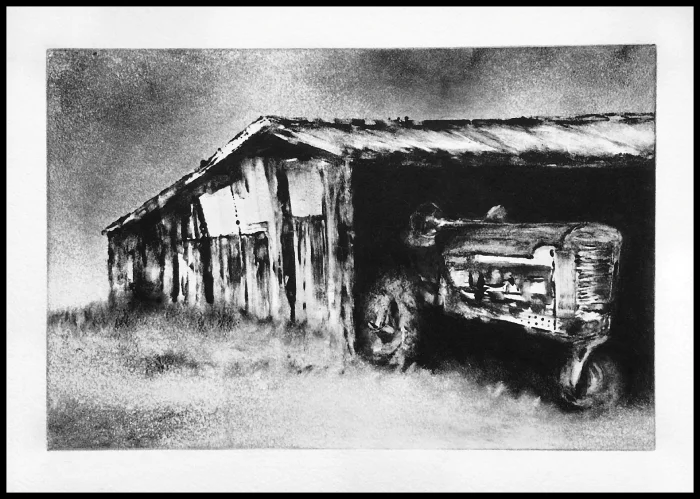
When we approached the village, I didn’t recognize the house. It felt strange because, in my memory, it stood there so vividly; yet, when the driver pulled over, I hesitated for a bit to open the gates.
I expected my grandmother to be outside, busily running across the front yard, but it was quiet and empty, and only a goat stood there chewing on the grass. I entered the house, and my aunt greeted me. I saw my grandmother sitting on the sofa in the living room, her body resembling that of a child. She was wearing gigantic wool socks, and her head was covered with a white scarf. She didn’t notice the noise my arrival had stirred. I went to my grandmother, hugged her and kissed her soft, drooping cheeks, then I said, “It’s me, Aizhan, don’t you recognize me?” She looked at me with her hollow eyes and said, “How have you been? I hope everything is fine.” I realized she had no idea who I was.
It had been nine years since I last saw my grandmother. Back in the summer of 2015, she began to show the first signs - a little too forgetful, a little too quiet, and a little too compulsive and erratic at times. But I was leaving for America, my parents were nervous, and I was anxious, and everybody was too busy with their own lives to pay closer attention to her.
Throughout the following years, when I called my mother and asked about her, she would shrug it off, saying, “She is forgetful, but you know, it is age; she is not getting younger.” I was building a new life in New York, trying to carve out a space for myself in my new marriage and the new city, while drowning in homesickness and loneliness. And while I missed my grandmother badly, I wasn’t in a full emotional capacity to worry about her enough and ring the alarm, while we could. But could we really?
My aunt prepared a dinner, a real feast - boiled meat with noodles, salads, pastries, fruits, and sweets scattered all over the table. “I told everyone you were coming today,” she said, and we waited for an hour, but nobody showed up. We sat at the enormous table - my aunt, her husband, and son, my grandmother, and I - and we began talking about our lives. “I wish you had brought your daughter,” my aunt said, but I couldn’t. The roads were still shattered, just the way they were shattered ten, twenty, thirty years ago. And while I didn’t mind travelling for hours on a bumpy road as a child, I knew my four-year-old daughter wouldn’t take it.
It was almost midnight when we finished dinner, and I helped my aunt clean the table. My uncle, my grandmother’s youngest son, said, “Your apa loves to walk at night. Don’t get scared if she comes to your room.” “And make sure you hide your socks. She loves picking them up and hiding them somewhere,” my aunt added. They laughed, and I laughed back, as if I had just heard something funny.
At night, I woke up startled. I saw something that I had only seen in horror movies: my grandmother lumbering around my bed, her long hair down, her eyes glistening in the moonlight. Stooped in her white gown, she looked like a witch. I got up and sighed, “Oh, apa, let me take you back to your bed.” I held her hand, and she didn’t hesitate. In the living room, she suddenly slumped into the sofa and closed her eyes. I covered her with a blanket and went back to my room. In my bed, I tried to make sense of everything I had witnessed that day. But my mind was blank. I felt nothing. In the morning, I couldn’t find my socks.
Every summer, my parents sent me to the village. My mother would pack my rucksack and take me to the station, where I boarded an old, battered Ikarus bus crowded with students heading back home, elderly men and women returning from the city, and exhausted moms with their crying babies. I didn’t mind the cloud of smell and noise that built up in that overcrowded bus. My excitement about the upcoming summer holidays in my favorite place in the world was bigger than all my senses.
It took all night to get there, as the roads were always broken. By five a.m., the driver would leave me on an empty road, refusing to make a detour to my village, as it was two and a half kilometers away from the main road. I would stand there all by myself, waiting for someone to pick me up. I loved those early mornings in the middle of the vast steppes, a little shivery, inhaling the bitter smell of sagebrush.
And then I would see her from afar, a small body walking briskly towards me. It was my grandmother who refused to wait any longer for the men in our house to pick me up and left on foot to meet me. We would hug each other, and she would pick up my bag, and we’d walk back to the village. On our way, she would tell me the latest news of the village. “Our cow, Martha, calved two days ago. I named her Isabella…” She loved giving the names of her favorite actresses from Mexican soap operas. “The neighbor bought a car, and now that old peacock doesn’t say hi to us…” she would laugh. Listening to my grandma talking about those mundane things was soothing to my soul.
Once we entered the summer house, where everybody was drinking their morning tea, the family would exclaim, “Are you already here? We were just going to pick you up!” The same old story was told over and over. They never managed to pick me up on time.
The house was always filled with people. Her three married sons, their wives, their children, friends, neighbors, and some passerby - all gravitated to my grandmother’s house from morning till midnight. The tractor would stand in the middle of the front yard, kids with dirty faces and hands gnawing on a piece of bread, chickens and lambs getting in the way, music from an old radio - the house was full of life. And my grandmother was the beating heart of that house.
I knew I would have the best time of my life. My cousin, who is a year younger than I, also lived there. We would spend three months together, inseparable. As children, we would play football until it was too dark to see the ball, play cards with other girls under the shed, hiding from the heat, and run off to a nearby tiny lake in the afternoons. In our teenage years, we would borrow the boys’ bikes and ride around the village for hours, pretending we were travelling around the world. At sixteen, I stole my uncle’s unfiltered cigarettes, and my cousin and I smoked behind the house when everybody was asleep. At seventeen, I tried my first beer. At eighteen, I fell in love with a village boy and dreamed of marrying him and staying there forever. With every visit there, something new would happen to me, and the only constant was my grandmother and her daily routine. While my cousin and I slept until noon, slowly crawling out of the cool house into the scorching day, our grandmother had already lived a whole life full of labor. She woke up at five, milked the cows, fed the cattle, made the cream on a separator, all the while talking to endless people coming and going throughout the morning. She always pretended to be angry with our lazy lifestyle and sometimes scolded us, but we knew it was all pretend, and she didn’t mind us sleeping in, because we were on holiday.
As we got older, she tried to teach us many things - to milk the cow (unsuccessfully), make butter from cream (boring!), draw out and twist fibers to make yarn (even more boring!), bake sourdough, and make kurt, sun-dried fermented balls, a favorite snack of every Kazakh child. But I was too busy with my youth - falling in love, dancing until morning, swimming in the cold, tiny lake, writing in my journal, listening to music, daydreaming, and creating all the drama in my head. Everything she tried to teach me, I shook off as a nuisance. It didn’t matter to me at the time.
In the village, I was the most creative and outspoken person, writing plays, directing, and casting the local kids, and later performing for our family and neighbors. I would wear the brightest and boldest colors and feel the most beautiful. All because I felt fully seen and accepted for who I was by my grandmother.
I was three months old when my mother left me with my grandmother in the village. She was twenty-two, doing her third year of medical school. I stayed there until I turned three, but I remember nothing from those early years. It seems that the part of my brain that was responsible for memory started recording only after I turned four. I don’t remember calling my grandmother mom, even though she often reminisced about that and told me repeatedly how badly I cried when my parents took me back.
Throughout those years growing up, I had a strange feeling of not fully belonging to my own family, yet I couldn’t live with my grandmother, no matter how much I wanted to.
I dreaded August. August marked the end of summer and my time in the village with my grandmother. Back in the city, it was a school full of drama, and my parents were constantly fighting.
The day of my departure, everybody would gather at our house, have dinner together, and then my grandma would slip money in my pocket, kiss me, and when I got in the car, she would wave at me and run after. This always broke my heart, and tears would stream down my face. And I knew I would have to wait for nine long months before I could come back.
In the morning, a couple of relatives came to say hi. We sat at the table having breakfast, while my grandma walked slowly from one corner of the house to another. She didn’t smile. She didn’t talk. Her face seemed tired, yet there was no expression. One of my uncle’s wives invited me to lunch at her place later that day. While waiting, I went through the photo album with my grandmother. I asked her about the people there. To every person, she said, “I don’t know him, I don’t remember her.” She didn’t recognize her two older children, who had died of cancer sixteen years ago, but when I showed her an old black-and-white photo of a young man, she exclaimed, “That’s Ahmet!” “Who is Ahmet?” I asked her, pretending not to know him. “Ahmet is my husband,” she answered with confidence. And for a fleeting moment, I almost saw my old grandmother, as if her memory was back, her facial expression was back. I wanted to exclaim, “Apa, you’re pretending, right?” I wanted her to burst into laughter and say, “Of course, I’m pretending. I tricked you, you little goose.” I wanted to catch that glimpse of her, hold on to it, but when I looked at her face, her eyes were hollow again.
Later in the afternoon, when we were heading to lunch, my aunt got angry at my grandmother. She pooped in her diaper right after it was changed. “Why didn’t you tell me? You never tell me!” she yelled at her behind the closed toilet doors. I wanted to beg her not to yell at her, but I was silent. I knew I had no right to demand anything from my aunt. She was the one who washed her, changed her adult diapers, dressed her, and fed her. When my toddler was messy, I knew it was a temporary phase. I knew she was growing and developing, and that one day she would learn to use the potty. When my grandmother was messy, I knew it would get worse.
We decided to walk to my uncle’s house as it was only five minutes away. My aunt and I held my grandmother’s hand on each side as she was dragging her feet. We had to stop every 10 seconds because my grandmother was out of breath. I looked around the village. It was unusually quiet. The neighbors’ houses were gone. The village was shrinking. Not only was my grandmother’s memory almost gone, but the whole place was slowly disappearing. And in that very moment, I suddenly realized how everything had changed irrevocably. My grandma, once so lively and busy, trudged slowly, so vulnerable and fragile now. I suddenly remembered how we used to walk together back home on those early mornings, and just like how it used to be in the past, I wanted to tell her everything. “I’m married… I have a four-year-old daughter… We live in Jersey City… I’m writing now… I’ve missed you so much…” And at this very moment, it hit me: I didn’t really know what she would say. That she was proud of me? But what else? Would she look into my eyes? Would she hold my hands? Would she smile at me? I thought I remembered her so well, but those memories were only fragments, like music clips. I didn’t know what it was like to talk to her anymore. I started forgetting her, too.
I had been thousands of miles away from her for nine long years, and all those years, I was so worried I wouldn’t be able to see her again. And now here I was holding her hands tightly, and I wasn’t sure if I had made it on time. She was right here, I felt her wrinkled skin and fragile bones, but she was so far away from me, locked inside her mind. I looked at her face, and all I saw was only my grandmother’s shadow.
I left the village the next day. My grandma was still sleeping after her night walks when I got in the car early in the morning. As the car moved, I looked back, but there was nobody waving at me or running after the car, only a beautiful sunrise filling the village with its ochre light.
I’m sitting at my desk in Jersey City, one year later, and trying to write about my trip to the village. I didn’t shed a single tear when I saw my grandmother last year or when I left. And I haven’t thought about her at all this entire year, as if my psyche intentionally shut down not to face the dread of not being recognized by your loved one. But now, while writing, I’m suddenly crying; the flow of my tears is so heavy that I have to change my shirt. For the first time, I’m willing to touch what I couldn’t even look at last year. My grandmother, who lost her husband at the age of 32 while pregnant with her fifth child, who worked for years three jobs to survive, who never saw places, who lost her two older children to cancer, who never had time to sit and process everything that had happened to her, who absorbed all the sadness inside her but kept moving and smiling, ended up having dementia. Part of me feels this tremendous rage for this injustice. But another part thinks, maybe this dementia is the first time in her whole life when she let go of all the control, anxiety, and painful memories and let her be this dependent child who is cared for by others. My aunt sends me videos of her spoon-feeding my grandmother and then cradling her in her arms. Perhaps this was all she had ever wanted her whole life.
Appeared in Issue Spring '26
Comments on "The Bitter Smell of Sagebrush"
Please log in to submit a comment.
Login