
Published May 11th, 2026
Review
A Praise Song for Creatures Big and Small — A Review of “They Gather Around Me, the Animals” by Kunjana Parashar
by Ashish Kumar Singh
Mumbai-based poet Kunjana Parashar won the 2024 Barbara Stevens Poetry Book Award, judged by Diane Seuss, for her debut poetry book They Gather Around Me, the Animals (NFSPS Press, 2025). The poet further received the Toto Funds the Arts Award and the Deepankar Khiwani Memorial Prize “for the quality of attention that she brings to the personal and the quotidian.” Her poems have been published in countless literary magazines and anthologies.
If the title as well as the cover of Kunjana Parashar’s collection They Gather Around Me, the Animals eluded the “aboutness” of the poems, then the dedication at the start, which is in itself a poem, leaves no doubt. “To pollen. To gadfly. Beetle of red,” it starts, continuing on, “To bees. To aphid / To lac bugs on a kusum tree” and ending with “to winter light and its simple oppression. Gold of scarabs. / Hermaphrodite snail. The eyes of eels.” It sets from the very beginning the tone and voice for the entire collection, much like Vikram Seth’s novel-in-verse The Golden Gate.
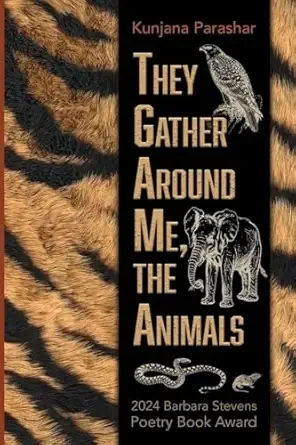
Though most contemporary poets choose to stay elusive, rejecting any concrete description of what they explore and convey, trying to remain as ambiguous and open to interpretation as possible, and echoing in some sense what Wallace Stevens once proclaimed that a poem should be “part of the res itself, and not about it,” Parashar’s poems gladly accept, and rightly so, their distinct nature of being only one thing: a praise song for the creaturely world. She not only sings for the big, visible, and majestic creatures that roam our planet — the blue whale, the black bears, the slithering snakes — but also for the small, hardly visible, and considered lowly among the animal kingdom — the fleas “plucked from her dog’s ears,” (p. 48) the squelchy frogs, and the bagworm. In the poem “On Not Cleaning the Bathroom,” Parashar sees the unseeable things that grow and proliferate in neglected corners — the sewer gnats, the earthworms, and the millipedes — and surprises us with a tenderness of words not often bestowed on them. Here, no one is left without praise.
Parashar writes beautifully. She showcases her brilliance with a multitude of forms. The poems range from songs to prose to elegies, and just like the animals within the pastures of these pages, they too blend perfectly with each other, giving readers poems that are, as put by Diane Seuss, “jubilant and elegiac at once.” In a group of prose poems all titled as “Poems with No [ ] in It,” Parashar explores the presence of the absent, or the possibility of their becoming one. She poses the essential question of what our lives would be like without the animals living in the vicinity of our homes. Imagine, she says, a world with “no more cocks announcing the coming of light” (p. 24) and “no more frogmouths signaling the arrival of night.” (p.24) Imagine a world where “dog owners pulled at the leash, but no one pulled back.” (p. 25) Imagine a dry world where “was once sap, once chloroplast, once sugar, once moist, now is only xeric soil.” (p. 29) Similarly, an erasure poem encapsulates perfectly this slow and gradual extinction of beauty and how what we are leaving for our children is nothing but evidence of our own brutal negligence. The poem ends with “oh, weep,” (p. 29) our delayed and pointless lamentation for things turned to ruins.

The language employed throughout this collection has the uniformity of diction — of place and of habitat, mixed in together with Parashar’s thorough research of the natural world. She is scientific in naming these creatures and their little eccentricities as well as mysterious, open to wonderment that comes only with being alert to one’s surroundings, or, as she puts it, when she is “never not listening.” (p. 12) Sounds play a very vital role. Each poem is brimming with a cacophony of voices, of vibrations of “insects yawp and trill,” (p. 24) “of black hoof,” (p. 58) “of teeth on tin roofs,” (p. 53) and “of crackles, pops, snaps, fish-grunts, and choruses.” (p. 61) Then there are the sounds the silence makes when we anticipate something to speak but it doesn’t, like days passing “without howl,” (p. 25) without the “songs of barks,” (p. 25) without “the hiss in the grass, hiss in the air.” (p. 27) The loss of creaturely sounds isn’t just a loss of minimal measure, she says, but of disastrous consequences, in which the loss is like “the ache of losing a language and so a whole culture.” (p. 27) However, Parashar is gentle with her reprimands. She blames humankind for these losses, these “glitches,” (p. 20) for our insatiable hunger, our “god of concrete,” (p. 19) but she never abandons her soft, tender, almost cooing voice, a quality so often attributed to works of Louise Glück and Mary Oliver. She makes us face our reckless follies and hopes that in the face of rising temperature and disappearing species, we will come to our senses and be cognizant of our need and our crucial dependency on other beings.
They Gather Around Me, the Animals is a faithful testament of Parashar’s love and devotion to the fauna of the world, as she expresses so sensitively in “I feel lonely / without animals / in my poems.” (p. 76) This is a kind and voluminous gift to all of us.
Want to learn Kunjana Parashar’s own thoughts on her writing? Check out our interview with her here: https://tintjournal.com/interview/ecological-consciousness-imbibed-in-poetic-sensibilities-in-conversation-with-kunjana-parashar
Comments on "A Praise Song for Creatures Big and Small — A Review of “They Gather Around Me, the Animals” by Kunjana Parashar"
Please log in to submit a comment.
Login