
Essay
The Sleeping Fox
by Francesca Chiari
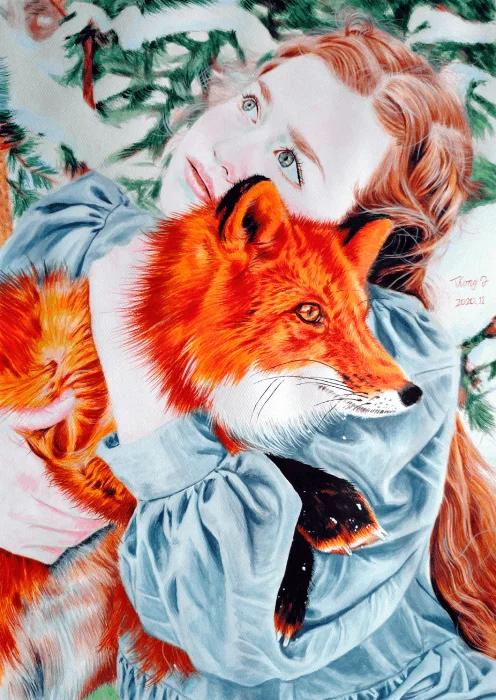
In a 2013 report, the Department for Environment, Food and Rural Affairs, estimated around 430,000 red foxes living in the United Kingdom, mostly in cities and on the southern coast. This roughly translates to a fox for every 150 people living in the country. Their survival skills allow them to thrive in any environment; they feed off rodents and birds, reptiles and eggs. Foxes don’t hibernate. Their thick coat allows them to survive the cold, and severe weather conditions are often enjoyable for them. Snow, for example, acts as insulation on their coats. They curl up in a ball, tuck their noses in their tails and fall asleep. Foxes feel warmth where we would feel cold. Had we known this, our behaviour would have been irrational. But of course, we didn’t know.
I saw my first English snow the day we found the sleeping fox. Our class was scheduled for the early afternoon, but both of our phones were buzzing with texts from our classmates saying they would not be able to make it to school due to the weather conditions. You texted me on our private chat:
Sounded like bullshit to me.
The snow was never heavy; it didn’t stick to the ground. It never does in England. That’s what you told me. I learnt it myself, eventually: a couple of snowflakes, dark clouds. But we move on.
Our class ended up being cancelled, and I asked you to come over, so your mum dropped you off on her way to work at the hospital. My host mum was away for the day, and we laughed at the idea of the old lady, with missing teeth and grey hair, driving her blue Honda along the coastline in the snow. Our laughter filled the walls of the empty house, and it was just us, forever, seventeen and happy, a warm cup of tea in our hands, wrapped in my blanket with Taylor Swift’s face printed over it.
You thought it was all so funny: my host mum, the Taylor Swift blanket, the tea drowned in milk because Yorkshire Tea, on its own, is too strong. You thought it was so funny that you needed a smoke. So, I opened the back door, the bitter breeze trespassing inside the house.
That’s when we saw the sleeping fox: its red coat covered in snowflakes, curled up like a ball with its big tail resting on the white coat that covered the garden.
You panicked: foxes are wild, they bite, you said. I had never seen a fox up close before. I insisted it was cold, insisted we should put the blanket on top of that tiny, tired body. We were so focused on the fox, that we forgot about smoking, and our cups of tea filled with snowflakes sitting on the table in the backyard.
At first, we were scared it wasn’t breathing; I walked closer to it, while you warned me not to touch it. We called Animal Protection, and they told us to wait. We sat on the doorstep and watched it persistently, sleeping in the cold. We took bathroom breaks one at a time, filling up our cups with warm water and curling our fingers around them. We did not leave the fox alone; we called Animal Protection again and again, insisting that the fox was cold and that they should tell us what to do before tragedy struck. The lady at the end of the phone tried to reassure us, telling us foxes are used to the cold, and that it was probably okay. By the end of the day, everyone at the East Sussex Animal Protection office knew our names. We were the crazy fox girls.
We sat on the doorstep until later in the evening. Your mum came to pick you up, and your tone filled with urgency as you told me to keep checking on the fox. The morning after, I promptly ran downstairs and went to the backyard to see if it was still there. The snow had melted, and the fox was gone. We forgot about it the week after.
The day I moved out of the house, two years after we had found the sleeping fox, you told me you had never realised how small my bedroom was until I had emptied it out. We painted the walls back to white and made sure to hide the marks left by my Marvel posters and the cigarette burns on the windowsill.
When I closed the door behind me, it was like I had never been there at all. I never told you how painful that last look was. I was not a child anymore. My existence in that house had been wiped out completely. I hugged you and my host mum goodbye, and you stood there, in front of the house that was not my house anymore, and you waved as the taxi took me away. You shouted, see you soon! and I put my head out of the car window and replied, not if I see you first. I don’t think you got the reference, but it didn’t matter. After all, friends come in and out of our lives like busboys in a restaurant. I never thought there’d be a love more powerful than that. I still don’t.
In the 70s, boroughs in London became responsible for their local foxes. The attempt to cull the species was unsuccessful, and it was eventually abandoned. By the beginning of the 80s, local foxes were once again free to roam around the city at night and they have, ever since, grown in population. From time to time, tourists and locals in the city will see a fox run across the road at night or hide in the bushes of the Royal Parks. They are accustomed to humans: they keep their distance and they don’t bite. Ever since that last attempt, the number of foxes in urban areas has been stable, and the animals have learnt how to live within the environment of big cities, feeding off rubbish in the streets. Their wild silhouettes in the light of lampposts in the city night is a juxtaposition that feels unreal. You have to see it to believe it.
When the Shard was being built, in south London, a fox entered the construction and made its way to the 72nd floor and lived there for a couple of days, feeding off whatever food the builders had left behind. Foxes are resourceful, they adapt quickly. They get used to change. They survive change. Eventually, the fox was taken under the care of Animal Protection and released back into urban life.
Two years later you came over to the Fitzrovia flat on your birthday; I ordered a Victoria Sponge from my favourite bakery in London and got you an original print ABBA vinyl I had found months before in a record store in Camden. That day, I remember insisting that you should have moved to London. You never did, and maybe you never wanted to. London was my dream, but I tried to force it upon you because I missed you. I missed you so much. I miss you so much.
When it was time to leave, you missed the train from Charing Cross and we walked to London Bridge hoping to catch one from there. On the way, as we were smoking and looking around, I pointed out the Shard and told you it was the tallest building in the world. Of course, I was wrong. You corrected me. I had nothing else to say, about the building, or about London, or about us.
I wish I had known then about the fox that had lived there, almost a decade before you and I ever met. I would have told you the story, and we would have taken it as a sign. We walked the rest of the way in silence. I never saw you again, after that day. Your life moved, and so did mine. The distance between the beaches and the city was too big, and we had grown into our new lives and out of each other’s. You stopped answering my phone calls and I stopped calling. But you were so happy in the photos your friends would post on Instagram and I realised, perhaps, we were never meant to be in each other’s lives forever. There were no tearful fights, no late-night conversations. You walked out from my life exactly like you had walked into it, in silence, slowly. I never realised you were gone until you were out of reach.
When I moved to my new house share in Marylebone, I hung photos of us on the walls, although we had stopped talking months before. I made new friends that I used to get drunk with at the Wetherspoon on the street opposite our flat. We’d always leave late at night, and I would see foxes hiding around the rubbish bins on the side of the road. I used to wonder if they were friends with our fox, and I was drunk enough to think that they were. I should tell you this. You’d think it’s funny. You’d laugh.
In London, foxes were everywhere. Perhaps this was the only thing about the city you would have liked. I saw one on the day I finished my dissertation by a pub in Brompton, one on the day my dad came to visit. I always wanted to text you about it, I always wanted to send you a photo. We were not friends anymore by then. I never told you how much I loved you: we were girls together, and that was enough. That is still enough.
By the time I moved out of London, the distance between the city and the coast didn’t feel so big anymore. I used to come down all the time, before America. I used to go to all our favourite places. I used to get a shit iced tea from the corner shop in the Old Town and drink it while I chain-smoked in the square with the chessboard painted on the ground. I used to order two slices of Victoria Sponge at the café we used to sit at for entire days. I used to imagine you were sitting in front of me. I never imagined I would walk those streets without you. Our town became a ghost town. I still see phantoms everywhere. My memory will always fail me before I turn any corner, and I will always think you are there, sitting down on the bench of the bus stop, smoking your last cigarette. I will always see you, for a brief moment; I will always live in the past.
The last time I came down, my mum and I walked the country lane that led from my old house to our old school. You and I used to meet up halfway and trespass through fields and fences to sit in the sun together, to smoke and read and talk. We used to talk so much: I never have anything to say now. You exhausted my last words.
I pointed out your house to my mother when we reached the end of Combe Valley Way. I said, that’s where I used to go, all the time. I hadn’t been there in ages. I pointed out the bus stop, the new housing complex at the intersection. Everything had stayed the same, but I had changed too much to notice.
Before I left, I had grown to know those roads so well that I had begun hating them. It was always dark. It was always cold. A day wouldn’t go by without a drop of rain. My mum said she couldn’t believe she had let me live in that crime-riddled town. I couldn’t believe it either. You used to tell me you wanted to leave, but, in the end, I think you never wanted to be anywhere else. This is something people will never understand. I used to take the bus from the town square to school and drive by all these pastel-coloured buildings, the sea on one side of the road and the parks on the other, the statue of Queen Victoria and the abandoned houses on top of the hill. I used to tell you that I wanted to die with a view of the beaches. I used to tell you that whenever we’d be old enough to give up on life, we could buy one of those houses, and we wouldn’t have to do anything all day, just look out the window and wait for the day to end.
In twenty years from now, it’ll be a harsh winter and I’ll be in a pub in North London and I’ll look outside, and I’ll see a fox sleeping in the snow; and I won’t make a big deal out of it, I won’t stare and wait to make sure it’s okay. Perhaps I’ll take a photo, and perhaps your phone number won’t have changed, and perhaps I’ll send it to you, and perhaps you’ll reply, and we will erase those twenty years like they never happened. And perhaps then, we’ll know more: about foxes, about distance, and about everything we had not yet learnt at seventeen.
Whenever I looked up my old address on Google Earth, I could still zoom into my window and see the spines of my books hidden behind the white curtains. The blue Honda still parked outside. They updated it now: the date at the bottom of the page reads May 2025. There is no universe where I still live in that house, where I still see you every day at school, where we are both seventeen and nothing has happened yet.
Sometimes I think about the sleeping fox. I wonder whose garden she sleeps in now. I wonder if you ever think about me.
Appeared in Issue Spring '26
Comments on "The Sleeping Fox"
Please log in to submit a comment.
Login