
Essay
A Bridge Between
by D.G. Rosales
We were halfway through assembling the dresser for the baby's room when we gave up.
The kind of giving up that happens in late pregnancy when everything feels heavy, and nothing is urgent until suddenly it is.
The Allen wrench had vanished into the gravity well beneath the couch, and I was afraid that if I looked, I’d find it beside one of those extra crib pegs and the afternoon would vanish into the black hole of Part C refusing to fit into Slot D despite what the instructions claimed.
So we retreated to the safety of the cushions, took refuge in The Great British Bake Off and let ourselves melt into the gentle drama of people fretting over handshakes and soggy bottoms.
One of the bakers was shaping a choux bun with trembling hands, and my wife scrolled through the baby names app we’d been checking for weeks. I glanced over as she turned the screen toward me.
“What do you think of this one?”
I smiled. “It’s on my list too.”
Her eyebrows lifted, playful and pleased. She tucked her feet under the brown fleece blanket — the queen-sized one we’d brought down from the bedroom and never bothered to return — like it was a secret she’d been saving.
There wasn’t a need for much more conversation; that’s the kind of quiet shorthand you get after years of partnership and a shared spreadsheet or two.
What I didn’t tell her, at least not then, was how much names had once haunted me. But she knew.
I was born Daniel. Da-NYEL. The Spanish version. The one with softness in the middle and just enough bite at the end to feel like it should be spelled with an ñ and an acento.
But when we moved to the U.S., that version of me got left behind somewhere between airport terminals. Customs didn’t confiscate it. No one demanded I say it differently. It just… shifted. Quietly. Reluctantly.
A cousin, trying to be funny, once asked, “You say that like Danielle? That’s a girl’s name, dude. Gross.”
It wasn’t malicious. Not really. But at that age, words don’t need to be cruel to take root. They just needed to be planted in the right soil. I started saying it differently after that. I stopped correcting strangers. I let people call me whatever version made their mouths more comfortable, until Daniel became Dan-yul, and something inside me twisted every time I heard it.
I didn’t know how to explain that it felt like I was being called the wrong name. Not a different name. The wrong one. Like it belonged to someone who couldn’t even roll their r’s.
Thanks to Gossip Girl, I was almost Dan. There's a character that writes himself into belonging. Maybe I could do the same with my name. But I already knew it was a bad fit. Too Anglo, too preppy. The kind of guy who throws lacrosse parties and calls his dad sir.
Daniel was still what appeared on official documents, the name on my McDonald’s name tag. But it wasn't mine anymore. It wasn’t just the pronunciation. It was the half-second hesitation in answering to it or the calculation in choosing what name they’d prefer to hear when introducing myself. It was knowing, implicitly, that my name was inconvenient.
And it was inconvenient. I was inconvenient. Standing out not because I was self-assured, but because I was a nuisance.
Only my family called me Dani.
It was intimate. Tender. A name grown out of frijoles Ducal and salsa Naturas, shaped by people who held me tight before I could say it myself, who knew to leave the last syllable light. Not like Donny, but like something that fluttered and rested in the throat. Con cariño.
So when I had to pick something to call myself, I landed on Danny. Not quite the open wound that giving up Dani would be, but American enough to fit, and close enough to feel like me.
It’s funny. It still isn’t quite who I was.
But it became who I am.
A compromise between tongues. A name that could live in both countries. A kind of patchwork identity, just like the rest of me.
“You know it works in English and Spanish,” I told my wife as we curled closer, her belly between us like the sun we orbited.
“And Italian,” she added, half-smirking.
I didn’t have to tell her about my relationship with names, just like she didn’t have to tell me about hers.
My wife was born Gabriella.
She chose Gabbi.
I think part of it was because she never fully connected with Gabriella — too formal, too old-world. Part of a culture she was never allowed to fully inherit. Her dad gave up on teaching them his dialect because it wasn’t “proper” Italian.
But a lot of it had to do with her mom, who insists on full names and correct spellings like it’s a moral issue.
Ironically, two out of her three daughters go by nicknames anyway. Only one played by her rules. My wife does things her way, choosing the highway instead and moving halfway down the East Coast for a fresh start.
Gabbi spent her whole life fielding versions of her name: Gaby, Gabby, even Gibby (yes, like iCarly). learning to correct people or turn jokes into armor. She didn’t want our baby to need that kind of strength, to have to be fluent in self-defense alongside his other languages.
My dad once visited us from Guatemala and brought a souvenir from my hometown — a hand-crafted wooden ship. On one side of it, carved in blocky script, it said “Dany y Gaby.” He expected us to display it. He was proud of it. But he brought it to the wrong people.
We appreciated it enough not to throw it away, but it hurt enough that it still sits forgotten in a closet.
If the people who are supposed to know you best can’t be bothered to get your name right, what hope do you have with those who don’t know you enough to care?
So maybe Gabbi inheriting a little of her mom’s rigidity isn’t a bad thing.
The name we chose was short enough to resist shortening and strong enough to stand on its own. Not just a bridge between English, Spanish, and Italian.
And suddenly that name — his name — felt like it had always been waiting for us, like it had just been biding its time in the background of conversations and app scrolls and the curve of our tongues.
We went back to our half-watched episode, but the room felt quieter. Something had shifted. A possibility had become a person.
His was a difficult birth.
Not dramatic, not Grey’s Anatomy intense, but long, painful and raw in ways neither of us had prepared for. Her body labored for over twenty-four hours, determined and relentless, drawing more strength than I’d ever be able to muster.
And when it was clear we’d need to go the surgical route, I saw the fear flicker in her eyes for just a moment before she smiled at me. A smile that said, I know you’re scared, so I’m going to be brave for the three of us.
The room was a blur of masks and gentle commands, of blue cloth and too-bright lights. I held her hand, and she held mine harder. I’ve never been more in love.
And then, through the hush and breath and waiting, he arrived.
All at once, and very slowly.
A quiet wail. A perfect, impossible face. The miracle of fingers and eyelashes and everything in place.
The nurse asked if we wanted to hold him, and the world felt complete.
We’d said his name before, but this was the first time we said it to him:
“Welcome to the world, Nico.”
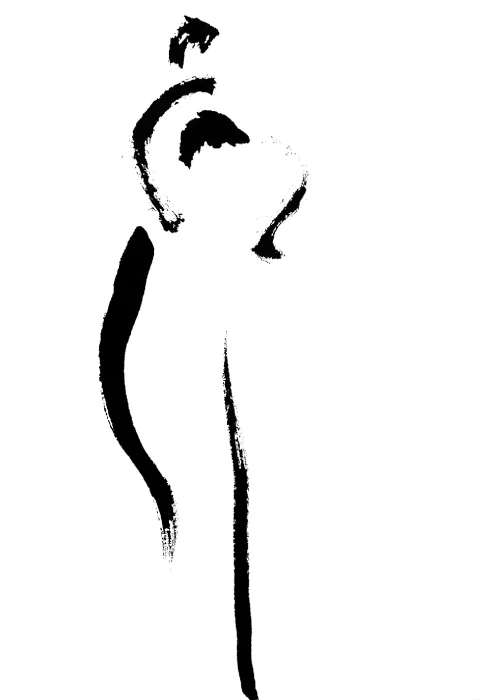
Note on the artwork:
Mimi Kunz
“Generations”, 2021
Ink painting on washi
First published in Mother Tongue (The Kyoudai Press, 2024)
https://mimikunz.com/mother-tongue/
Appeared in Issue Spring '26
Comments on "A Bridge Between"
Please log in to submit a comment.
Login