
Short Story
The Thing We Buried
by Ethel Maqeda
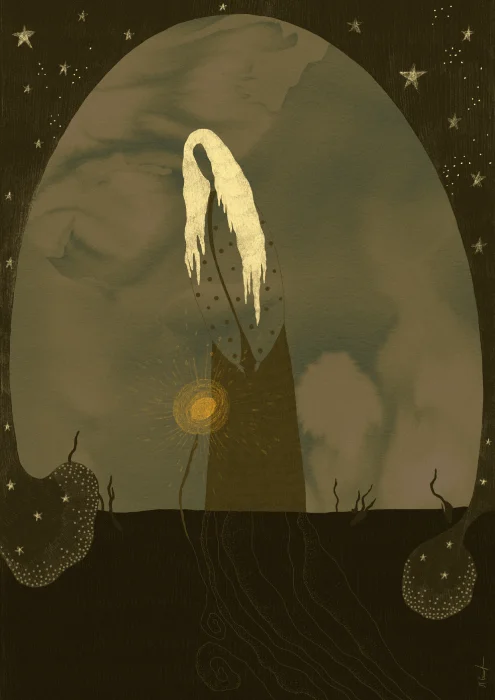
Only Tabonga still remembered their bush. Even after all these years, it remained clear to her. But when she tried to remember it with her friends, she was met with raised eyebrows and shrugs — though never the same way twice.
People remember the more remarkable landmarks. Monuments. Rivers. Schools. Churches. The room where they first locked eyes with the love of their life. The park where they first understood loss. Their grandmother’s quiet kitchen, where the argument about their father leaving for the gold mines ended, and the plates stayed untouched for days. Not a bush. Not that bush — surrounded by savannah scrubland, like any other for kilometres around.
It was a sickle bush, thorny and tangled, rising to shoulder height. They were small then; they could not see much beyond it. Yet there it stood in Tabonga’s mind — alive, humming with cicadas, smelling of dust, dry leaves and sunburnt grass.
Even back then, to anyone else, it was just another thorny bush at the foot of a nameless hill — a tangle of sickle bush, thorny vines, and weeds, mostly visited by the village goats. Once, a vine snake lay hidden among the branches, looking like one of them until it moved, sending Tabonga and the others scattering in all directions.
But for Tabonga and her friends, it had been a whole world. Their playground and shelter from heat and rain. Their confessional, where secrets slipped out. A refuge from whippings after broken plates or muddy feet on freshly scrubbed floors. Their school too, of things they were told not to ask about. Things that were meant for adult minds.
The sickle bush at the bottom of the nameless hill had once felt like the centre of the universe. That is, until the doll came.
It happened on a Friday afternoon, the kind that smelled of sunburnt grass and paraffin.
She lay on the veranda, watching, while a huge pot of mutakura bubbled away on the primus stove.
Her mother had left strict instructions: Tabonga, don't touch anything, don't go beyond the veranda, come get me when the baby wakes up.
But the instructions hadn’t said anything about the milk bakkie arriving. It was the wrong day. The farmer and his servant came on Saturdays, and as far as she knew, they had never brought anyone else with them.
Yet here they were: the farmer in a khaki safari suit, with his house servant in blue overalls, their growling dog with watery eyes, and a girl, with hair the colour of dry grass, cradling a bundle — all arriving in a bakkie on the open ground in front of the houses. The girl was perched on a chair tied fast to the railings at the back, and the servant was holding tight to the railing in a futile attempt to stop the jerrycan he was sitting on from toppling.
As this was an unusual happening, Tabonga hoped her mother might forget the slight misstep. She wandered first to the mango tree just beyond the veranda, its shadow cool against her feet. If her mother returned at this point, she could say she'd gone for a drink from the drum in the shade — a harmless fib.
Beyond the mango tree lay the chicken run — the last safe boundary before guaranteed punishment. But curiosity pulled Tabonga farther. Drawn as if by some invisible hand, she crept to the edge of the open ground, pausing there, still and breathless, eyes fixed on the girl, watching without blinking.
The girl was smaller, younger. The servant lifted her from the chair so she could edge forward and take in what was happening. His hands were gentle but sure. Her red polka-dot dress bunched at the waist, her knobbly knees pale against the green bakkie and red dust.
Once more he lifted her, slow and careful, and set her on a milk can. From there she could watch the people arrive, their movements disturbing the quiet air around her.
Knott, the white man, collected the money. The coins disappeared into the fur of his hands. He reminded her of a gorilla. MaReport measured and poured. He was called that because he was rumoured to be a spy for the white people. In his absence, people called him MaReport Mubhoyi waKnott — Knott’s Boy, The Reporter. The little girl sat, still and poised, eyes wide and silent. She cradled a bundle wrapped in a white shawl, like the one Tabonga’s mother had knitted for the baby. The dog crouched, taut, waiting for a moment that had not yet arrived.
People came and went: some with large plastic pails, others with jugs, and others still with kango cups. The moment the dog had been waiting for never arrived. He shuffled back to the front of the bakkie and waited by the door, ears stiff, tail still. The clatter passed without him. White men’s dogs were not to be trifled with. Everybody had shuffled forward until it was their turn, proffered their container, and handed over the money. No dogs were needed. Not today.
Tabonga had been rooted a short distance from the bakkie, her eyes locked on the girl and the bundle, unmoving, suspended between curiosity and caution.
Knott lifted the dog onto the passenger seat, careful and slow, like shifting something already cracked. MaReport shifted the milk cans, smoothing the girl back into her chair, hands lingering, almost afraid to let go. The bakkie stirred, a low hum under their feet, then tipped sharply into the turn.
MaReport’s arms closed around the cans, tight, pleading with gravity not to spill,
and for a moment, nothing moved. The girl shot a pale hand out, a thick leather belt crossing her body tightly, fastening her to the chair, itself tied in place — so tight that even a cyclone would not have dislodged it.
And then they were gone. The bakkie, Knott, MaReport, the girl, the dog — all vanished in a soft puff of dust, spiralling toward Knott’s homestead. The narrow dirt road leading to Knott’s homestead, a forbidden place, lay just beyond the ridge — the border between what they knew and what they did not — and where the punishment for stepping too close had not yet even been imagined. All she was sure of was that the punishment would involve fathers, and no one wanted fathers involved.
When the dust settled, she saw it — too clean, too light to belong to the soil that now cradled it. Tabonga moved forward, mother forgotten, each step careful, silent. It lay face down in the dirt, one small arm twisted behind its back, as if the earth had tried to fold it into itself and failed.
At first, she thought it was a baby. Then, almost without thinking, she nudged it with her foot, turned it over, and froze.
Its skin was the colour of old ivory, warmed by dust and handling. The red dress had softened at the edges, its polka dots bleeding faintly with age. Over it sat a frilled cardigan, off-white like sunbleached cloth. Its hair was a dull, trapped gold, matted as if it had never been combed. When Tabonga tilted it, the eyes clicked open. They were blue, glassy, almost human. It was a smaller version of the girl in the bakkie if her mother had forgotten to brush her golden mane and rubbed her face in the earth.
She stood still, not daring to breathe.
Then she heard a whisper, "It's a doll." She looked around, but nobody was there. Everyone had vanished back to their chores, carrying their pails and jugs of milk, leaving the air still and the dust settling in slow spirals.
She crouched and extended her hand, then jerked it back as if shocked. She tried again. This time she touched it and began to trace the angles of the plastic body. She smoothed the dress, righted the contorted arm, and brushed the earth off its face. She picked it up and cradled it, the way her mother cradled the baby.
For a moment, she thought of returning it. It seemed the right thing to do. But something in the way the doll looked — the pale, perfect face, the frilly lace framing its snow-white cardigan, the dress, the red stilettos — made it hard to let go.
“She's ours now," she heard the whisper again.
She was certain the others would recognise her efforts. After all, they had all congratulated Tau when he discovered a mutamba tree no one had ever seen before. That tree now belonged to them, heavy with fruit, and allowed them to spend the entire day outside without worrying about needing to go home before sunset. No being trapped there doing chores or watching sleeping babies.
But a doll… a doll was even rarer than a mutamba tree. None of the children she knew — or even the others in the village — had ever owned one. They wrapped stripped maize cobs in scraps of rug from their mothers’ sewing baskets and tied them to their backs, pretending they were babies, but it wasn't the same. None of those makeshift dolls had a proper head, arms, legs, or clothes. A real doll was a treasure beyond her imagination.
She was right. When the others had finally recovered from their initial shock, they burst into leaps and whoops of joy, their laughter echoing through the air. Arms flailed, feet pounded the ground, and faces shone with wonder, as if the world itself had grown brighter in that very moment. They only calmed down when Shami, the oldest, reminded them that if the adults found out, there would be untold consequences. Stealing from a white person, lying, the bush, the mutamba tree — it would be the end of it all. The end of their world, untouched by adult meddling.
They stopped laughing and spoke in low voices, arguing as though the thing had already moved beyond joke or game. “It’s just a toy,” one of them said, already backing away from her own certainty. “It’s a toy baby,” another insisted, as if naming it would make it less forbidden. “It’s not a baby,” someone else whispered. “It’s something that brings trouble.” And another, quieter than the rest, said it was lucky — because things that fall into their world unbidden and do not break must mean something else.
No one agreed, and no one moved.
In the end, they decided only to keep it for a while, and not to speak of it to anyone. So they stood there in the dust, each of them holding a different version of the same thing, and saying nothing more.
They washed her in the shallow stream, careful not to let the muddy water touch her face. They took turns combing her matted hair with a twig and laid her in a shoebox lined with dry leaves and bits of cotton. They named her Sadie because someone said that's what white people called their dolls.
And for a week, Sadie lived among them, something they could not name aloud. They were never sure what she was. Sometimes she was a baby. Sometimes she was something that only pretended to be one. They built her a house under the sickle bush, complete with a roof of broad, green, shiny leaves stolen from the vegetable patch behind the houses. They took turns rocking her to sleep, feeding her imaginary porridge, even scolding her in the few English phrases they knew, “come here,” “sit down,” “good morning, sir or madam,” when she cried.
But the spell broke as quickly as it had begun.
Her mother's baby — the real one, Moira — fell ill. At first, it was a small thing: a whimper, a fever. Then came the crying, sharp and endless, and the angry rash on her bottom. Her mother blamed the heat, the flies, the dirty nappies. But the women who came to help had their own theories: babies are fragile spirits; no evil should be around them. They sense these things. Keep the baby’s father out of your bed for a while. Give her boiled water with a bit of sugar and salt. Give her some zumbani you chewed for her first — it settles the stomach.
It was when one of them said, “You don’t keep things that aren’t yours, especially things which do not belong here,” that Tabonga wanted the ground to open up and swallow her.
They all looked at her then, the way grown-ups do when they already know the truth. It felt as though the adults had known all along. Their frequent, meticulously timed visits to the bush had not fooled anyone. She tried to tell them she hadn’t stolen it — that she’d meant to take it back and was just looking after it until the white girl returned, that it was just a toy, that she hadn’t meant any harm. But the more she spoke, the guiltier she felt.
It was true that Sadie felt heavier on some days more than a toy or play baby. Moira had been restless and irritable before she even found the doll. That is why mum had left her watching Moira even though she was only going next door. That evening, when Moira’s fever rose again, her father had brought some medicine from the chemist. Her mother gave it to Moira as instructed, and Tabonga watched as it was spooned carefully between small, burning lips. Afterwards, she snuck out and ran to the bush. The others followed without a word. She knelt and began clawing at the earth. Soon they were all digging, with sticks, with stones, with their hands.
They dug into the red earth, damp from last week’s rain, pushing past the dry crust.
Sadie lay swaddled in newspaper — The Rhodesia Herald, the letters already smudged and unreadable. Tabonga didn’t know what any of the words said or meant.
When the sticks could no longer reach into the grave, they stopped. Someone lifted Sadie and laid her gently inside. No one did anything, but something inside her shifted, like earth settling after it had been turned. No one said a prayer. No one cried. They did not sing. Nothing.
By morning, Moira’s fever had broken.
No one said what had done it. The medicine sat on the shelf. The earth stayed where it was. The bush did not move.
Years later, when she was grown and living in a city where sickle bushes could not take root, she would sometimes dream of that bush. In her dreams, it was always late afternoon — the sky swollen with heat, the air thick with the smell of dust and paraffin smoke. She would push through the shrubs and find the spot where they had buried the doll.
She could see it clearly: Sadie's face half-buried in the soil, her blue eyes faded, one hand reaching up through the roots as if asking to be found. In those dreams, she never touched it. She just stood there, feeling the same mixture of wonder and dread that she'd felt as a child and the guilt that clung like dust that never washed away.
When she went home years later for her mother’s funeral, she found the hill without difficulty. The village had changed. The prison fence was gone. The school building stood in crumbling plaster. But the bush was still there. Faded, thinner, yet unmistakable.
She stood before it for a long time. The wind moved through the branches, stirring the dry leaves. For a moment, she heard it — a faint click. She smiled then, not out of joy, but out of the strange relief of remembering.
Appeared in Issue Fall '26
Comments on "The Thing We Buried"
Please log in to submit a comment.
Login