
Short Story
The Other Side
by Somrwita Guha
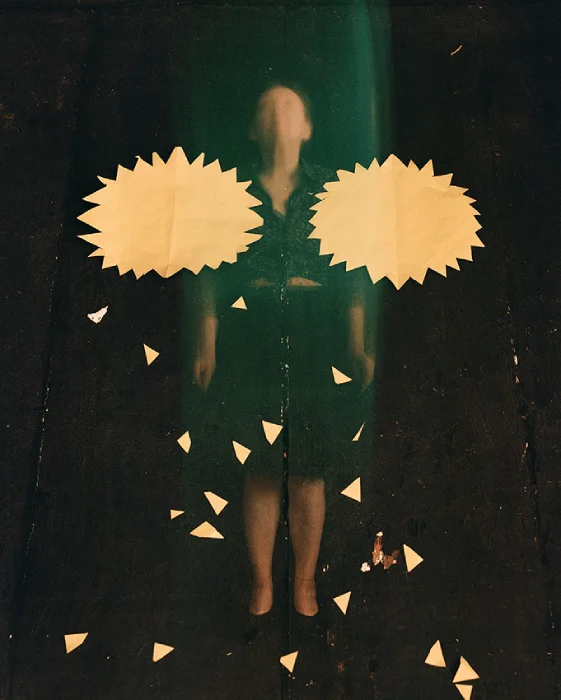
I knew something was wrong the moment I saw the shoes. It wasn’t the usual neat line of sandals, school shoes, and the battered floaters my uncles wore to the bazaar. Instead, a crowd of sombre, adult leather ones were scattered in urgency. It was as if their owners had rushed in without a second thought.
I was 9 years old and just back from school. My socks sagged at the ankles, and my tiffin box was still sticky with vegetable curry. The air felt wrong. The ceiling fan spun in our narrow hallway as if it had forgotten what it was meant to cool. There were voices I didn’t recognise — men clearing their throats too often, women sobbing. The curtain to the living room was drawn shut, a rarity in a household that had nothing to hide.
“Maa, why are so many people at our place?”
“Dida isn’t well,” Maa replied. “They’ve all come to see her.”
Dida had been unwell on and off for as long as I could remember — illness was her baseline. A cough that lingered, like gossip, and a breath that seemed laboured. But illness didn’t bring shoes scattered at our threshold.
Then someone asked, “When did it happen?”
“Around 12:30 p. m.,” said my aunt.
I was 9 years old. I hadn’t lost anyone to death before. I didn’t know the choreography of loss — the hushed tones, the sudden silences, and the way adults looked at the floor rather than at each other. I didn’t know what I was supposed to feel, but I knew enough to start piecing things together. For one, no one ever visited in such numbers when Dida was unwell. And illness didn’t draw out the phrase, “When did it happen?”
Maa called out from the kitchen, “Wash your hands. Lunch is ready. There’s chicken curry.” She scooped a soft, white hill of rice onto my steel plate, then poured the curry beside it. A sheen of oil circled the edges like a halo. Two pieces of chicken floated in the gravy: one a leg, the other a soft, falling-apart piece from the breast. A slice of boiled potato was half-submerged, like a secret unsure whether to reveal itself. I stared at my plate.
The smell rose, warm and familiar: onion slow fried to sweetness, garlic crushed by hand, with a whisper of bay leaf and cardamom. It should have made me hungry. I picked at the rice with my fingers, pressing it into a little ball, just as Dida had taught me. I put it in my mouth and chewed. The flavours bloomed, and yet it tasted wrong.
Every afternoon after lunch, I used to go to Dida’s room. Every visit began with the same question: “Did you eat?” Dida always said it like an incantation, as if fullness were a ward against misfortune.
Her room was darker than the rest of the house, its single window half-covered by a curtain stitched from an old saree. Sunlight came in slivers, dust suspended like particles of memory caught mid-flight. The air hummed with coconut oil, camphor, and the faint, persistent smell of medicine. It was not a smell the rest of the family liked, but I didn’t mind. To me, that was the smell of Dida.
I lay on her bed, my legs swinging, next to her carved wooden trunk. That trunk held things I thought were too magical to be real: glass bangles wrapped in newspaper, an old comb with missing teeth, a photograph of my grandfather, and letters written in a script I couldn’t read.
After that came the stories — stories not found in the books Maa bought me. Dida’s stories flickered like half-formed dreams. Sometimes they came from One Thousand and One Nights — cities of brass, jinns trapped in jars, and merchants who spoke the language of animals. But often, the stories slipped their disguises. They were memories dressed as fiction.
“It was night,” she’d begin, her voice lowering. “The sky was dark, the river darker. We carried nothing but what we wore. There were 30 of us on the boat — maybe more. Some cried, some prayed. Others just held their breath and hoped not to be noticed. All we wanted was to reach the other side alive.”
Dida always paused here. Overhead, the fan turned, stirring the silence.
“We weren’t born here,” she’d say, “and we didn’t arrive — we fled.”
I’d ask, “From what?”
Dida never answered right away. After a pause, she’d say, “From the wrong side of a line someone else drew.”
She would describe what they had left behind: a house with a tulsi plant in the courtyard, a brass swing, and a mirror so tall it showed your whole self. She told me about Bhulo, the dog who ran after the boat until his barking turned into a distant dot on the water.
“And when we reached the other side,” she’d continue, “the men said we were safe. Yet no one tells you safety is also a kind of exile.” Dida said they gave her a new ration card and a new address, but she never stopped writing letters to the old one.
I didn’t understand it then. I thought it was just another story, one that belonged next to flying carpets and singing wells. I do now, after flipping through a thousand books on the dreadful partition of the subcontinent following Indian independence from British colonial rule. Back then, it lived in the same part of my mind as all her other tales: shimmering, half-true, a little scary, and utterly hers. I didn’t know then that I would one day walk into the same room not for stories but for silence.
For me, there was no one to cross-check with. Maa had already said Dida was ill. I knew better — she was lying. Yet I played along, unsure how to ask the unaskable. I never learned how my aunt had broken the news to my two cousins — whether she had delivered it bluntly or spun another gentle falsehood. In hindsight, I see the peril Maa faced: a young woman burdened with the task of telling me something that would shatter my world. Or perhaps she was determined to finish off the chicken curry, as the family had no appetite for it once death had touched our door. To her, I was still a child — unaware, innocent — and feeding me was both a comfort and a duty.
At the sink, as I washed my mouth, Maa wrapped her arms around me and said, “Dida has become a star.” It was a classic euphemism for death, designed to make the eerie seem beautiful. How else would one explain something so profound and strange to a 9-year-old? Dida has become a star.
My stomach rebelled. I threw up the curry and rice, and the flavours turned bitter. Tears followed, along with Maa’s hug, heavy with guilt. I remember her hushed conversation with my aunt afterwards, murmuring that she shouldn’t have broken the news to me right after lunch. I wanted to relieve her of the guilt by admitting I’d known all along, yet remained silent. Somehow I had managed to delay the tears and even eat the curry, as if running on autopilot until an adult’s confirmation shattered my fragile facade. And then, with the truth finally laid bare, the vomit and tears erupted together.
That day, as my daily ritual, I set off for Dida’s room — only now, she had become a star. I navigated through a sea of people to reach her room. It was crowded too. She lay there on the bed like the other days, but her eyes were closed and did not open when I entered. There were tulsi leaves — one on each of her closed eyelids. Her body was frail and small. She did not call out to me saying “Momoo.” I did not cry when I saw her. I did not cry much at all after that.
In fact, I remember later that afternoon I was playing a board game — Monopoly — with my cousins and the other kids who had come to our house. I understand now that the adults were busy with logistics, and the children were best kept busy with some distraction. It was, strangely, a fun afternoon.
In the evening, however, the atmosphere shifted again. It grew quieter, tenser. They brought her down from her room to the front of our house. She lay on a wooden bed — one made for the dead. The bed was decorated with white flowers. The flowers smelled like the ones we had for festivals. She was covered in a white cloth, only her face visible. A sandalwood paste pattern marked her forehead. That was how a dead person looked, I noted, filing the memory away for future reference.
They loaded her bed onto a lorry, with my dad and uncles climbing in. All the women, except Dida, and the children stayed back. To my 9-year-old understanding, the cremation ground was a place where women didn’t go — unless they were dead. I didn’t know then what cremation meant. I couldn’t grasp that in just a few hours Dida’s body, the one that had cradled me, whispered stories, and smelled of coconut oil, would be reduced to nothing but ash.
In the weeks that followed, I took Dida’s room. It wasn’t declared or decided — it just happened. Someone suggested it made sense. Her things were packed away in suitcases and trunks, her clothes folded into mothball-scented piles and placed atop the Godrej almirah. The bed was dusted, and the curtains washed. And then I was told I could study there if I wanted, where it was quieter. At first, I said no.
For days, I sat at the threshold. The room felt altered, as though it had been paused mid-sentence. Her absence hummed louder than the fan. I kept expecting to hear her voice float out, asking me if I’d eaten. I didn’t cross over — not really — until the school holidays began. One afternoon, I took my notebook and a pencil and sat at her desk, the one pushed up against the window where the sunlight filtered in at an angle. That was the beginning.
Over time, the room shifted from hers to mine. Not all at once, but like layers of paint drying over the old surface. My schoolbooks piled higher on the table. I taped up charts on the walls — geography, multiplication tables, and a solar system that never hung straight. The carved wooden trunk remained, but its magic receded. I still never touched the letters.
I spoke to her sometimes — out loud at first, then in whispers, then silently. I imagined her watching me from a celestial veranda, nodding with quiet approval. I told her when I got good marks, or when I fought with my sister, or when I’d eaten too many mangoes and my stomach hurt. Sometimes, I imagined she would answer.
At night, I’d return to the other room to sleep beside my sister. I couldn’t bear the full dark of Dida’s room alone. But in the daytime, it became a kind of refuge, a place to hold my questions without needing answers.
As I grew older, the room bore witness to all the versions of me: the sulking preteen, the teenager scribbling dramatic poems in secret, the college student pouring over partition literature and finally understanding what Dida had meant by the wrong side of a line. The room held it all.
Seventeen years have passed. In that time, I’ve heard of deaths — on the news, from neighbours, and distant relatives. I have sent condolences through WhatsApp messages and on Facebook walls. But in these seventeen years no one close to me had crossed over to the other side.
Until last week; I returned home from work. I already knew, of course. The phone call had come earlier — quiet, clipped, efficient. But still, when I climbed the stairs and turned the corner to our apartment, it was the scattered shoes that undid me. Some things you never forget. They wait at the doorstep of memory, like a crowd of shoes.
Appeared in Issue Spring '26
Comments on "The Other Side"
Please log in to submit a comment.
Login