
Short Story
Dust
by Olga Ruchina
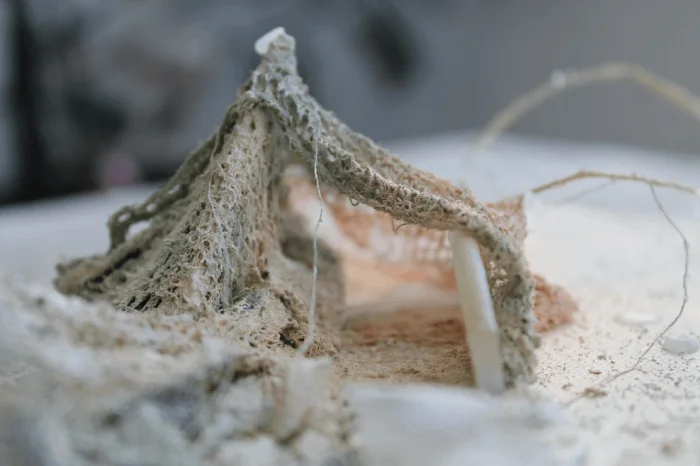
I am an archive of suffering.
I’m 25 years old. Ancient, by our standards. Most of us live a week or two, maybe a few months if they’re lucky enough to hide in the narrow gap between a wardrobe and the wall, where sunlight never reaches and the air smells of old glue, faded wallpaper, and time. A rare few survive for centuries: they settle into cracks in wooden floors, weave themselves into carpets, cling to ceilings beneath fallen plaster, or blanket the attics of abandoned houses, the corners of crypts where even the air feels frozen and eternal, like a memory that refuses to fade.
I’m lucky. I get to see the sun.
It arrives every day, slow and reluctant, gliding across the wall until it brushes my weightless edge. Then I drift into its glow, becoming a swirl of golden powder. Sunbeams carve the room into bright slices, pulling a new day out of the darkness. They fall across the torn mattress in the corner. There hasn’t been a bed here in years; he sold it during a desperate moment. Desperate, that’s a word no one in this room says out loud. He claims he needs nothing from anyone. But desperation here smells like cheap liquor, sour fabric, and loneliness.
The sun is here today.
The man on the mattress squints. He mutters under his breath, curses as if there were someone listening. His hand scrapes across the floor; something made of glass tips over and rolls away. I know what he’s searching for. Reaching farther, he finds a blue plastic bottle, crushed in the middle like a broken accordion. Two drops fall onto his tongue. Empty.
He curses again, louder and uglier, as though anger might fill the bottle for him.
I would bring him a drink if I could.
I settle onto his eyelids. His lashes are the same color as me. It’s the color of ash, old cobwebs, a dandelion gone to seed, the color of the moths that have taken over the only wardrobe in the corner. Inside hibernate the clothes he dragged home from the nearest dumpster: someone’s fur coat, a coat that once mattered, and a pair of trousers with no owner. He never opens that wardrobe. He keeps all his actual belongings piled on a chair.
I drift onto his face — the one covered in fresh scratches — and land on his stubble. It pricks me from all sides. Last night they argued over who had it worse back in the USSR. He lost, of course; it wasn’t a fair fight. I lift myself off his cheek and settle on his head. His hair is gray and thinning, a bald spot right in the center like a crater. He brushes me away. I take offense and float toward the wooden table.
I land on a faded photograph. A woman is smiling in front of a car. She is wearing a bright dress. Her hair is long; her hands rest on a pregnant belly. A note is written in pen: August 1991, Leningrad. The ink has blurred, just like the lower right corner of the photo. Yesterday, during that same argument, someone accidentally drowned it in vodka.
He walks to the toilet. Yellow droplets splash across the chipped enamel, across the floor of cracked tiles, across the old newspapers he uses instead of toilet paper. Welcome, droplets. We’re going to be here for a long time. You’ll harden, turn into something like drops of wax, and add another layer of ammonia to this room’s bouquet.
He shuffles toward the sink, its surface stained the color of old brick. He brushes a fly off the faucet and brings his mouth to the thin stream of water. His Adam’s apple moves up and down as he drinks. After a minute he pauses, tilts his head, cracks his neck. He digs through his pockets, pulls out a pack of cigarettes, then tosses it to the floor. Empty.
He opens the fridge, and I see the soft light of the dim bulb. I’ve been living on that bulb for a long time, woven my body into its glass. A week ago, there was nothing inside the fridge but this light. Then an older woman came with a plastic bag and a purse. She arranged two rolls of sausage, a jar of red soup, pastries, and milk on the shelves. She didn’t say a word. Only sighed when she saw me everywhere: on the handles, on the walls, on the glass. She grabbed a cloth, wetted it, and swept me away in one motion. But I gathered myself into the folds of the cloth and clung to the creases of her hands.
From the mattress, without opening his eyes, he murmured, “Mom, why are you doing this?”
She looked at him. Tears glimmered in her eyes. I’d like to believe they were there because of me.
“They gave me the number of a doctor. He can help. We only need your consent,” she said instead of answering his question.
“Go away,” he snorted and rolled onto his other side.
The woman wiped her tears with wrinkled fingers. She returned the cloth to the sink and pulled photographs and documents from her purse.
“You were brilliant once,” she whispered. “An engineering diploma with honors… What happened to you?”
He lifted his head. His eyes were dull, unfocused.
“Go away,” he repeated, louder this time, still refusing to look at her.
“Skill doesn’t disappear,” she said quietly. “You’re only fifty.”
“Are you deaf?” he snapped, sitting up with his fists clenched. “Go away!”
She flinched, stepped back, snatched up her purse.
“As your mother, I wish you only well,” she said, closing the door behind her.
He rose from the mattress, hurriedly gathered all the photos except one, and tossed them into the trash. He picked up the diploma, removed the supplement, and tore it into two perfectly even pieces. He crumpled a primary school certificate for exemplary penmanship. I wove myself into the flow of his thoughts. Forty years ago, his mother had ripped a page from his notebook and, just as he was doing now, had crumpled it. He had to rewrite the exercise. Again. And again. Until the handwriting became flawless. Too bad life didn’t let you rip a page out and start over.
He closes the fridge. Inside, there’s nothing left but the sausage. He slices it with a dull knife, but his hands tremble, and the pieces come out jagged, each bearing its own peculiar deformity. He bends down for the bread. It lies on the floor, chewed. The piece survived yesterday’s drinking binge, but I haven’t yet had the chance to cling to it with my weightless presence.
He lays uneven slices of sausage on a piece of bread. Then he brings it to his mouth. Usually, he places the meat directly on his tongue — it tastes better that way — but today, it’s different. He doesn’t care. He bites into the sandwich with his yellowed teeth and swallows immediately.
There’s a dull, insistent knocking at the door. He pretends not to hear it, continuing to gulp down bites of the sandwich. The knocking gets louder.
“Open up!” shouts a familiar voice.
I hear the sound spreading through the stairwell. He doesn’t move. I slip into his head and settle on his thoughts. I tremble along with his thin body. I feel his urge to run, to fall apart, to hide under the mattress where he keeps his cigarette butts. He inhales sharply, and with that breath, he pulls in pieces of me. I sit in his nostrils, tickling the receptors, making him jittery.
“I’ve got a surprise for you!” The voice outside sounds cheerful.
I become his memory, his past. I curl into a ball inside his head, like an old film reel, and play frame by frame before him. Twenty-five years ago, someone came to him with the same kind of “surprise.” There were three of them. Each held an AK-47 in one hand, a baseball bat in the other. Back then, he had been glad that his wife had left, taking their daughter with her. Otherwise, they would have been the first to suffer.
“I know you’re home!” the voice shouts again.
They took everything that day, everything he had built over the years, every penny earned.
“At least you’re alive,” his mother had said later, but she hadn’t let him stay in her home.
He understood that she feared the same gang might come for him — and for her and her younger son — so he spent the night at the train station.
The knocking continues. He finishes the sandwich, brushes the crumbs off with his hand, and heads for the door. When he opens it, a friend stands there, barely on his feet.
“Hey!” he says, holding out a bottle of whiskey.
My man looks at the bottle, at his friend’s trembling fingers, at his cloudy eyes. He has never drunk this kind of whiskey before. The black label says Jack Daniel’s.
“Where did you get this?” he asks.
The friend smiles drunkenly.
“Let’s just say… it’s a gift from… the government,” he chokes on his own breath, barely holding back a gag.
“I don’t drink stolen alcohol,” my man says quietly, closing the door.
The room becomes a closed world again, where it’s just him and me. He lies down on the mattress, closes his eyes. I feel his steady breathing, carrying the scent of the sausage and the lingering trace of yesterday’s alcohol. Suddenly, there’s knocking at the door again, but this time soft, barely audible.
“Dad, it’s me,” a voice says from behind the door.
He opens his eyes, scans the room. He doesn’t move. He doesn’t breathe.
“I… I know you’re home,” she knocks again.
He rises from the mattress and approaches a chair piled with clothes. He sniffs one pair of pants, then another. He turns a pair of underwear inside out and puts it on. Over that, he pulls on pants with two stripes along the sides.
“Why are you here?” he asks, opening the door.
“I have news,” she says, waiting for an invitation to come inside — to get a cup of lukewarm tea with three spoons of white sugar, as they used to do when she came home from music school, waiting for dinner.
He doesn’t move.
“I’m engaged,” she says, showing him a diamond ring.
“Good for you,” he steps forward, then stops and steps back. “I’m not paying for the wedding.”
She looks around the room. She sees the mattress, the cluttered chair, the fridge behind him, the walls I have claimed.
“I know,” she says. “Will you come to the wedding? It’s this August.”
He catches her gaze. What does he see in it? Pity? Shame?
“I’ll buy you a suit,” she adds. “Or my fiancé will give you his old one…”
He flinches.
“I don’t need anything!”
He slams the door. The crash reverberates through me, and I shatter across the room in echoes.
Evening falls. He drinks the whiskey with his friend, nibbling on the remaining slices of sausage. The fridge is empty now. I can claim the entire space. The walls. The cold air. With each passing day, I grow stronger, merging with my host. I am 25, and I feel we don’t have much time left.
Appeared in Issue Spring '26
Comments on "Dust"
Please log in to submit a comment.
Login