
Published October 19th, 2026
Review
Tremendous Emotional Range and Intellectual Curiosity — A Review of "Mantras of the Moon" by Srijani Mitra
by Anurag Ray
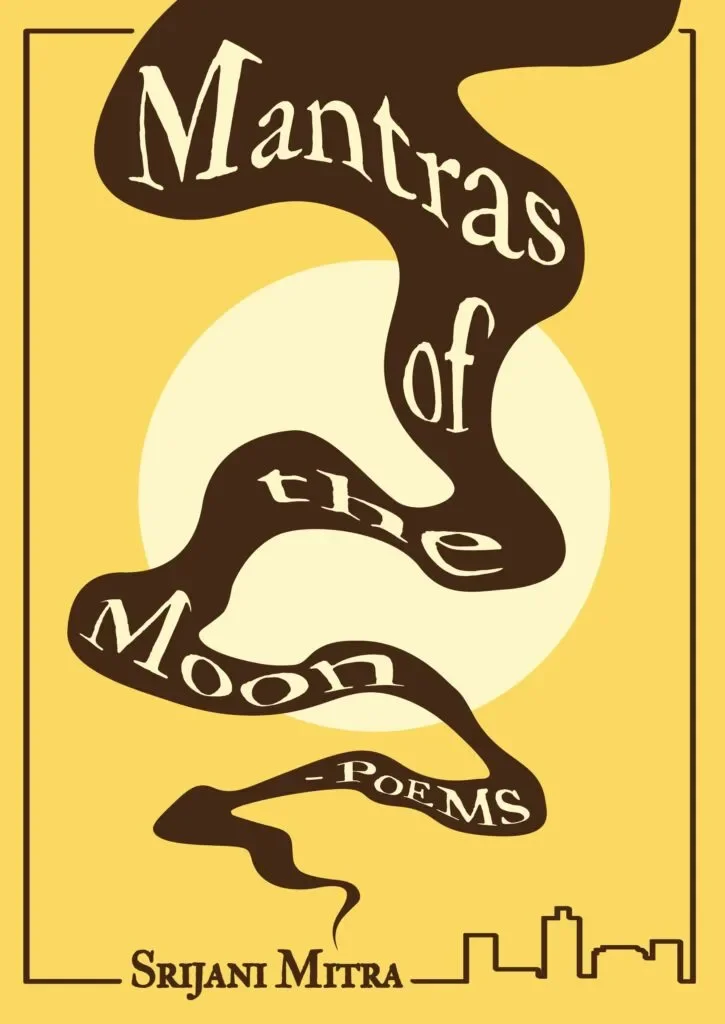
In her debut anthology of 31 poems titled Mantras of the Moon (University of Alabama Press, 2026), Srijani Mitra not only observes the world around her, but also metabolises it, transforms it into something intimate and luminous, and then returns it to the reader. The book, which she dedicates to her grandmother and late grandfather, is a collection of tremendous emotional range. It arrives with the sureness of a voice that has clearly been listening to itself for a very long time.
***
The very first poem, “At The Haridwar Ghat,” establishes the emotional grammar that governs the rest of the book. The image of a diya floating down the Ganges, picked up by slender pink fingers and returned to the dark waters, is a metaphor for how lives are shaped: “Burning and dousing, taking in all the warmth to only, eventually / give back to the silence of the river, ocean, sea.” (p. 3).
The collection’s motif is the frame, photographic, architectural, and psychological. In many of the poems, Mitra returns to old sepia-toned photos, ancestral drawers, family albums, portraits, and museums. In “Portrait in Adbhutam Bhava,” she invokes the Rasa tradition and braids it into deeply personal verse. Memory is a major obsession in this collection. Mitra repeatedly returns to the Gestalt principle — the idea that the whole is more than the sum of its parts — and applies it to emotional life. For her, memory is fragmentary, painful, and yet stubbornly redemptive: “Memories scatter in the unknown angular slants of light, broken into uncountable pieces – beloyari, glass like yet joining.” (p. 9). This is one of several instances where the poet switches, with beautiful naturalness, letting Bengali words anchor the poem in ways no English translation could replicate.
Water, rivers, oceans, rain, monsoon, run through the collection consistently and with force. The Ganges at Haridwar, the river at Murshidabad, the ocean in Dream Islands, and rain in many other poems use water as both a spiritual medium and a psychological landscape. In “Self-Portrait as Ocean Bed,” she writes: “I lie, drowned and flattened in the spread, water above, a deep longing beneath —” (p. 47). This is one of the collection’s most viscerally honest moments. In “Portrait with Saraswati Puja and Interrogations about Mantras,” Mitra chants mantras, questions the invocation of Vishnu, and refuses the comfort of submission without examination. “...I question the integrity, within and externally, suddenly” (p.12), she writes (p. 12). The poem is long, discursive, and deliberately unresolved.
The travel poems — Haridwar, Amritsar, Murshidabad, Indian Museum, Jwalamukhi — are some of the most radiantly observed. “Residence,” her ode to Kolkata, is an extended love song: “A city Byzantine with its oli golis winding as mangy mazes in tetul twilight.” (p. 32). She compares the image of a tamarind-coloured twilight to the narrow lanes of the city. In “Knowledge of the Body,” “What I Desire This Summer Day,” and “Defence Mechanisms,” the poet interrogates desire through the vocabulary of psychology: thalamus, cortex, Freudian sublimation, limbic systems. This is unusual territory for lyric poetry, where scientific language is held up against erotic longing to witness what each does to the other. Mitra’s style is lush, associative, and adventurous. She uses white space expressively to create pauses that function almost musically. She is a poet of bold and compound imagery: “Sky — chunks of sandalwood, the heart a museum of unavoidable pain, the welkin just the colour of halwa.” (Amritsar Safar, p. 36).

However, the collection’s ambition sometimes feels unevenly executed. “On Saraswati Pujo, 2022,” particularly, feels more like raw emotional notes than a finished poem. Some of the longer pieces might benefit from tighter architecture. Mitra’s extravagant language, which is her great strength, can occasionally work against her. But these are just some of the growing pains of a genuine talent finding its fullest form.
Mantras of the Moon is both intellectually serious and emotionally generous. Multiple traditions, Bengali culture, Indian philosophical aesthetics, Western psychology, and feminist mythography, come together to create a striking and original collection. This is a collection about what we keep, in drawers, in photographs, in the smoked frames of memory, and what keeps us, whether we welcome it or not. It is a book that rewards and moves. Srijani Mitra is a poet worth reading now, and worth watching closely in the years ahead.
Comments on "Tremendous Emotional Range and Intellectual Curiosity — A Review of "Mantras of the Moon" by Srijani Mitra"
Please log in to submit a comment.
Login