
Published June 22nd, 2026
Review
The Woman Behind the Goddess — A Review of “The Forest of Enchantments” by Chitra Banerjee Divakaruni
by Jana Yin
For centuries, Sita has been worshipped in India as the embodiment of strength, righteousness, and devotion. In The Forest of Enchantments (HarperCollins India, 2019), Chitra Banerjee Divakaruni invites us to look beyond that reverence and encounter Sita as a woman — one who questions, endures, and is shaped by the trials imposed upon her. Stripping away the surface of familiar retellings, Divakaruni brings us closer to a truth people have long refused to hear.
***
The Ramayan is one of India’s most revered mythological epics. Its stories have travelled across generations, retold by grandparents and finding their place even in the textbooks of young children. Often translated as “The Journey of Ram,” the Ramayan is attributed to the sage Valmiki. The epic follows Ram, the son of King Dasharath, and his wife Sita — their tale of coming together, living together, and finally, remaining apart for the rest of their lives.
Chitra Banerjee Divakaruni once again wields her sword — her pen — to restore justice to the woman at the heart of the story. She has long upheld her work in honour of the feminine voice, as seen in her other works such as The Palace of Illusions (Doubleday, 2008) and The Last Queen (HarperCollins, 2021). In The Forest of Enchantments, she offers readers an intimate glimpse into Sita’s inner world, her life, and her struggles, long ignored by the world.
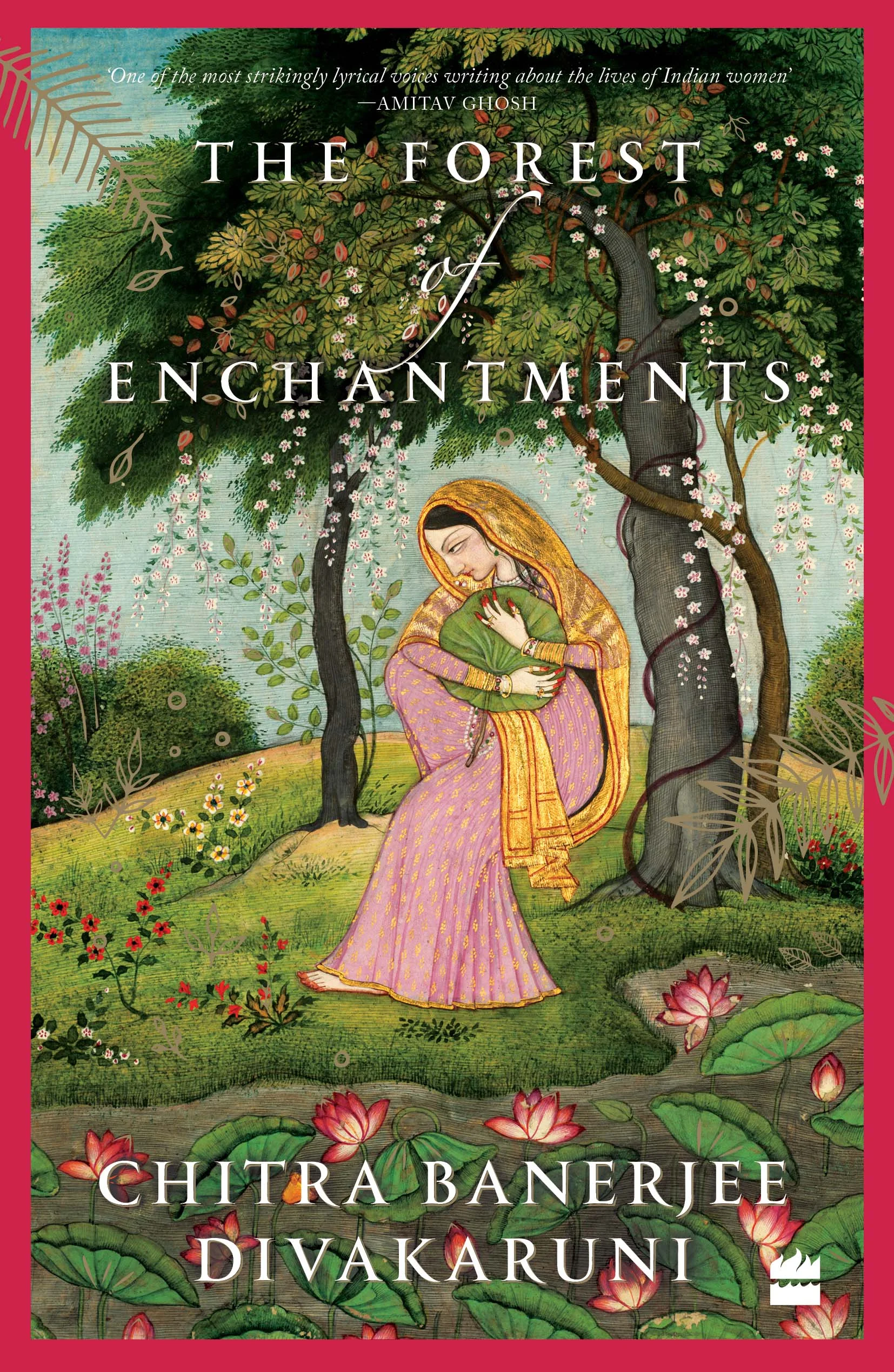
Most importantly, Divakaruni writes from Sita’s perspective, allowing her to tell her own story. As Divakaruni notes in her introduction, Sitayan — the journey of Sita — was never written by anyone, and so Sita must write it herself. It would be fair to say that The Forest of Enchantments is a modern mythology. Divakaruni initiates a literary revolution by reclaiming the voice of a character whose story has long been fixed and viewed from a single angle; she enchants us by placing a kaleidoscope in our hands.
Through this retelling from her perspective, we encounter Sita not merely as a symbol of devotion and love as she has always been portrayed, but as a woman of strength and resolve, who follows Lord Ram and Lakshman, his stepbrother, into fourteen years of exile without hesitation when Ram is banished from the royal court of Ayodhya by his stepmother, Kaikeyi.
Ram and his wife Sita are believed to be incarnations of the Hindu gods Lord Vishnu and Goddess Lakshmi. Because of this, Sita has long been seen as a divine figure, worshipped and praised for her endurance and love. But Divakaruni strikes the reader’s mind with her words and opens their hearts with truth, urging them to see Sita not as a goddess but as a woman who silently suffers through circumstances she never deserved.
When Sita is kidnapped by Ravan, the ten-headed Rakshasa (demon) king of Lanka and the main antagonist of the novel, the classics confine her to the dungeons for a year. Her suffering remains largely in the shadows. Divakaruni brings Sita’s story into the light. She makes us feel Sita’s longing for the life she once lived, the quiet ache of her heart, the hope that diminished day by day, and the unwavering love she carried for her beloved husband.

As we live with her through the pages, we feel anger and humiliation when Ram, the husband she loves and longs to see, tells her that his duty is fulfilled, that he has saved her, and that she is free to go wherever she chooses.
By the end of the book, we don’t just know Sita; we have lived as her. The reader feels nothing but empathy for Sita. As a woman, reading her story, her decisions, her unspoken thoughts, and her actions makes it impossible not to step into her thorn-filled shoes and feel the pain of her entire journey as Ram’s wife.
Divakaruni’s way of bringing out a new interpretation without changing a single part of the original plot is highly admirable. Even if a reader is familiar with Valmiki’s Ramayan, Divakaruni’s The Forest of Enchantments, also known as Sitayan, will feel like an unexplored forest.
Ironically, Sita’s story remains painfully relatable even today because, despite centuries of human evolution and technological breakthroughs, the way society looks at, perceives, and projects women has barely shifted. Her parents, the people of both Mithila and Ayodhya, her husband, everyone knew she was special, yet they treated her like a tender flower, valued more for her fragrance than her strength, meant only for display. Divakaruni reclaims Sita as an icon of self-respect and unyielding will when she refuses to walk through fire to prove her purity to the world. Her heart burns and she becomes the fire itself.
And that’s why, before she returns to the earth from which she was born, Sita tells us “And finally, I bless my daughters, who are yet unborn. I pray that, if life tests them — as sooner or later life is bound to do — they’ll be able to stand steadfast and think carefully, using their hearts as well as their heads, understanding when they need to compromise, and knowing when they must not” (Epilogue, p. 357).
Comments on "The Woman Behind the Goddess — A Review of “The Forest of Enchantments” by Chitra Banerjee Divakaruni"
Please log in to submit a comment.
Login