
Published March 2nd, 2026
Review
The Forbidden Freedom — A Review of Sindhu Rajasekaran’s “Forbidden Desire: How the British Stole India’s Queer Pasts and Queer Futures”
by Kabir Deb
Indian civilization and its history have long been liberal about the human body, its desire, and sexual plurality, treating love and sexuality as lived realities rather than obscenities. This openness has always allowed diverse forms of intimacy to flourish without censorship. Sindhu Rajasekaran’s Forbidden Desire: How the British Stole India’s Queer Pasts and Queer Futures (S&S India, 2025) examines how colonial rule erased this evolved inheritance by oppressing womxn’s sexual agency and criminalising queer love, while also recovering its precolonial presence. Written from the perspective of a womxn navigating a society that has grown increasingly judgmental and phobic, this book of non-fiction blends history, anthropology and lucid reasoning to reclaim India’s queer past and imagine a freer future.
In the introduction of the book, Rajasekaran writes, “as postcolonial subjects, we have been indoctrinated to think of the past as necessarily regressive vis-à-vis the present,” (p. XV) stating that India’s past has not endorsed the homophobic and rape culture of India, which the fringe is spreading today in the name of Bharatiya sabhyata (Indian civilization). But, at the same time, she also loudly accepts that the discriminatory violence in the name of caste, class and sex have always prevailed, but they had to meet the resisting forces which dissented to thrive. Later, after the invasion of the British, as the writer points out, the focus went to liberating Indian women who were hyperfeminine from oppression and subjugation. However, their orthodoxy made them oppose the concept of gender fluidity. The writer states, “Colonial authorities branded all ‘native’ womxn who defied heteropatriarchal norms as ‘prostitutes’” (p. XIX). The womxn who resisted Brahminical patriarchy were “categorised as transgressive womxn” (p. XIX) and their identity was criminalized.
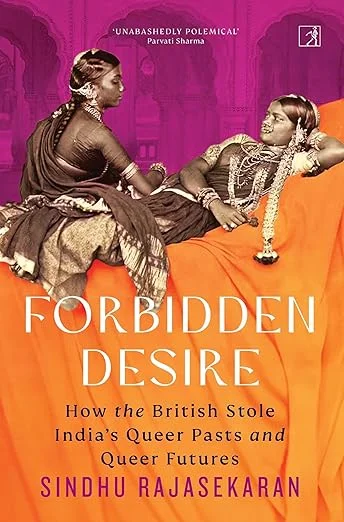
As the book unfolds, the author traces the long-standing presence of gender fluidity within Indian religions, highlighting its acceptance across social hierarchies. While discussing Kama prior to introducing the Kamasutra, the writer notes that “patriarchy critiqued womxn who used their ‘sexual capital’ for non-procreational activities, but nobody could stop them from doing so,” (p. 2) revealing a paradoxical freedom within rigid boundaries. Rajasekaran further observes that hijras, or transgender individuals, were seen as “trustworthy, intelligent and passionately loyal and they were granted unfettered access throughout to allow them to play a dominant role” (p. 2). The book also explores how Vedanta and Tantra uphold androgyny, citing Hindu texts where Kali’s fierce form contrasted with her gentler incarnation as Sati; Vishnu’s transformation into Mohini, which challenges hypermasculinity; and the cross-dressing of Radha and Krishna in the Bhagavata Purana, all reflecting an enduring acceptance of gender fluidity.
By tracing facts and anthropological essays, Rajasekaran states that after the British invasion, the colonial officials and soldiers were sexually drawn towards “native” womxn since India did not have codes and conducts on desire and sexual prowess. Due to the liberal attitude of Indian womxn towards polygamy and polyamory, colonizers fell in love with “native” womxn and, subsequently, married them. However, “18th century England was busy in constructing its ‘national character’ which entailed seeing the domestic realm as an ‘idealized’ space for the production of a virtuous and moral nation,” (p. 25) which further made them stringent towards the queer community and sexually-liberating womxn. The East India company forced a rigid and orthodox version of Christianity over its army deployed in the subcontinent, which made them stand against the pagan beliefs in Europe and the free Hindu beliefs in India.
Rajasekaran notes that “the fact that troves of Indian womxn participated in the 1857 Mutiny of Indian Independence got the British all jittery,” (p. 35) arguing that patriarchal anxiety and puritanical morality pushed the colonizers to introduce laws aimed at curbing (fe)male agency. She further observes that even after the uprising, British soldiers remained drawn to Indian men and women — an attraction that directly contradicted the Company’s self-appointed mission to “civilize” India. As Rajasekaran writes, “the dangers of Indian womxn’s sexuality were in the spotlight again, not as a matter of personal titillation, but as a serious subject of the State” (p. 36). Sexual liberation thus became a political threat, prompting the enforcement of feudal laws such as the Indian Contagious Diseases Act (1864), which branded sexually autonomous womxn as “prostitutes,” and Section 377 of the IPC (1861), which “not only criminalized sexual acts ‘against the order of nature’ but also forbade all forms of ‘native’ homosocial ties” (p. 37).
As the book progresses, Rajasekaran foregrounds the social acceptance of polyamory and polyandry across ancient, medieval, and early modern India. However, the 1857 Sepoy Mutiny once again hardened colonial anxieties. As she notes, “to the civilizing British mind, harems and zenanas represented the heights of sexual depravity” (p. 87). This perception stood in sharp contrast to reality. Women who inhabited these spaces were often independent and sexually self-aware. Historically designed to evade patriarchal surveillance, these quarters were “considered private and cut off from the world of mxn,” (p. 88) allowing them to function as sites where gender fluidity could be explored and dissent quietly nurtured against dominant social norms.
The British officials shamed people who visited these zenanas and later, they also manipulated the books written on queers to make the relationship appear unnatural and obscene to the patriarchs of India. Manusmriti, a patriarchal Hindu text, further helped them in controlling the Brahmin community and made the perversion of their feudal ideas easier than ever. Their primary focus was to curb the homosexual polyamory since in harems and zenanas it was making an uproar and when the writer says, “they didn’t have much luck with heterosexual folks,” (p. 95) it shows that the fluidity of gender was an attack on their puritanism. So, Rajasekaran writes, “queer polyamory was altogether criminal, and as a result, ‘native’ heteropatriarchy won out” (p. 95).
Rajasekaran also argues that the colonial idea of the “deviant womxn” emerged from historical anxieties about women who fought alongside men, often wearing attire deemed unfeminine. She notes that “the British considered ‘cross-dressing’ altogether inappropriate and indicative of ‘deviant female sexuality’” (p. 99). This logic echoed earlier European practices in which womxn were branded “witches” and burned for their acceptance of sexual fluidity and anti-patriarchal defiance. In 18th and 19th century India, however, “masculinities and femininities were not hardbound conceptions tied to people’s genitals” (p. 106). Courtesans were open about their lesbian relationships, and homoerotic pleasure was neither clandestine nor taboo. Yet the British reclassified these women as “prostitutes.” As Rajasekaran writes, “noble ladies who’d earlier taken pleasure in homoeroticism, with the knowledge of the patriarchs in their lives, were ordered to stop, lest they be categorised as prostitutes” (p. 106). Beneath this moral panic lay a deeper fear, an acknowledgement that desire, by its very nature, is fluid.
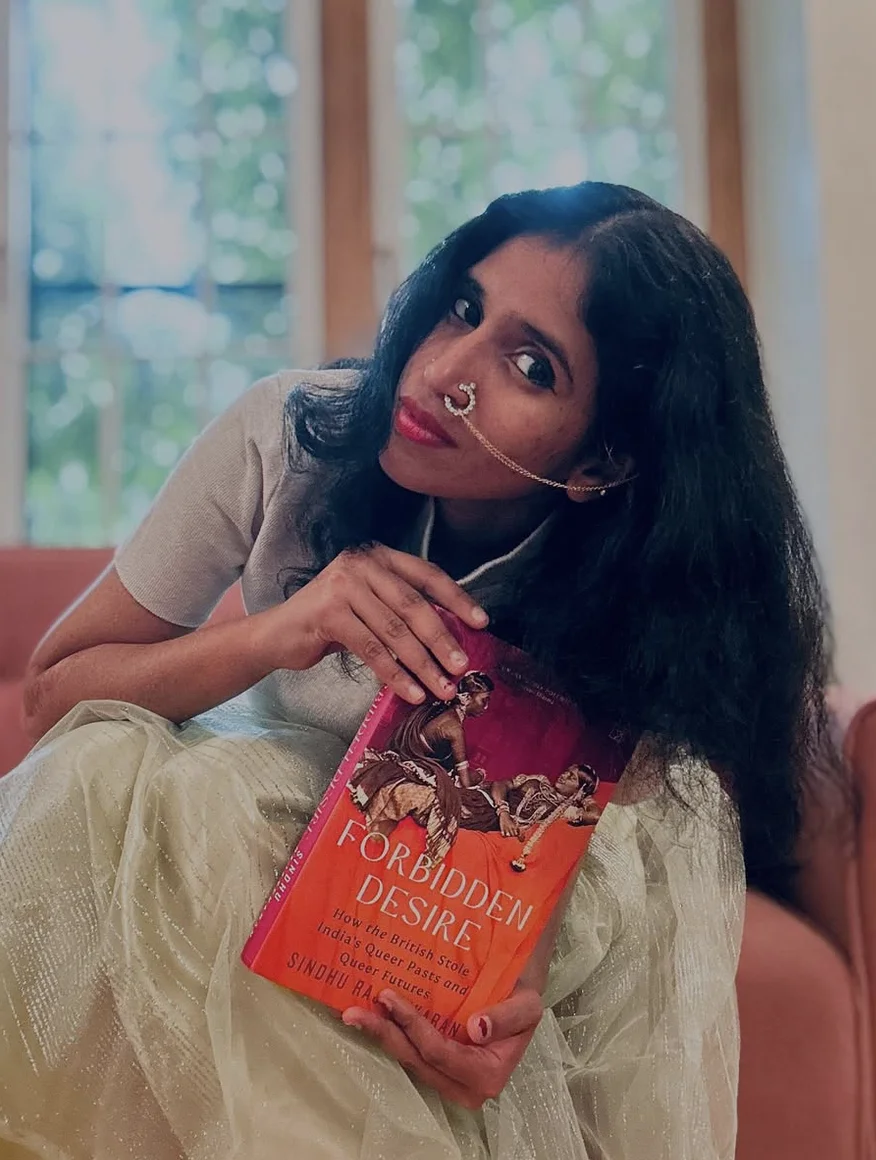
In the chapter “Bhadralok Types: Gay, Gayer, Gayest,” Rajasekaran argues that British contempt for the “natives” was not confined to gender or religion. As she notes, “the colonial officers made free to appraise the characteristics of Hindus, Muslims, Sikhs, the rich, the poor, the Brahmins, the Shudras” (p. 155). She cites Lord Thomas Macaulay’s depiction of Hindus as sedentary, delicate, and languid — a stereotyping that, she suggests, continues to fuel Hindu men’s anxiety about proving their masculinity. Muslims, meanwhile, were framed as pleasure-seeking perverts, classified simultaneously as a “martial caste” and as proponents of homoerotic desire. What the British ultimately despised, Rajasekaran contends, was the perceived queerness embedded across religious identities. Their so-called civilizing mission emerged from a worldview that cast subaltern communities as “primitive, heathen, hedonistic folks” (p. 157). For the colonizers, “hedonistic” became a catch-all term for the non-normative comprising homosexual, transsexual, asexual, hypersexual, or simply sexual beyond colonial moral limits.
Rajasekaran’s project of decolonisation rests on a crucial contradiction: While the British abolished practices such as sati, paedophilia, infanticide, and underage marriage, their puritanism also “erased traditions that served to transcend class, caste, and gender in a highly restrictive society” (p. 193). In her discussion of dance, she shows how Bharatanatyam enables gender to move fluidly — a performer may embody the masculine, feminine, or neuter at any moment. She also urges readers to be attentive to the terms used for queers across Indian languages, particularly when the community is represented at national and international forums. Decolonisation, she insists, must begin with personal experience and self-reflection.
Forbidden Desire: How the British Stole India’s Queer Pasts and Queer Futures is a vital text for understanding how Indian civilization historically perceived and engaged with the queer community. It urges readers to interrogate contemporary assumptions about queerness — assumptions deeply shaped by colonial education — and to begin the slow, necessary process of decolonization. India’s past, the book suggests, already holds the answers we seek. As we grapple with questions about queer bodies, desires, sexuality, and love, Sindhu Rajasekaran’s work gently yet insistently nudges us to return to history, where these freedoms were once acknowledged, articulated, and lived.
Comments on "The Forbidden Freedom — A Review of Sindhu Rajasekaran’s “Forbidden Desire: How the British Stole India’s Queer Pasts and Queer Futures”"
Please log in to submit a comment.
Login