
Published September 7th, 2026
Review
On the End of the World — A Review of “Under the Blue” by Oana Aristide
by Lisa Schantl
How do you imagine the end of the world? — Wait, let me rephrase: How do you imagine the end of the human species: Will we cease to exist due to a pandemic that washes over the globe? Will a nuclear catastrophe as a result of war, of technological failure, or of humanity’s tendency to prefer short-term solutions over long-lasting effects destroy our legacy? Will the many substrata of environmental damage — hunger, drought, fire, rising sea levels, war, [fill in your favorites] — bring about our downfall? Or, will AI take over and decide that Earth is better off without a species which is, to their algorithmic understanding, obviously seeking self-destruction?
***
Whichever one is your favorite or worst nightmare — one of these scenarios would certainly be enough to propel the planet into its next era.
Transylvanian-British author Oana Aristide takes doomsday a step further and explores all these plausibilities in one book. Under the Blue (Serpent’s Tail, 2021) tells the story of middle-aged artist Harry and his two companions, the sisters Ash and Jessie, as they struggle to survive in the aftermath of a pandemic that was set in motion by the melting of the permafrost. On top of that, the world goes dark without electricity, and consequently the cooling systems of the nuclear reactors are facing an expiration date.
This tragedy is countered by the tale of two researchers, Lisa and Paul, who are based at a remote research camp where they work on the development of a yet unseen artificial intelligence superpower. This power goes by the name of Talos XI, a Large Language Model that is continuously fed with historical, scientific, and ethical data with the eventual goal to better the conditions on the planet and prevent humanity’s (self-)erasure.
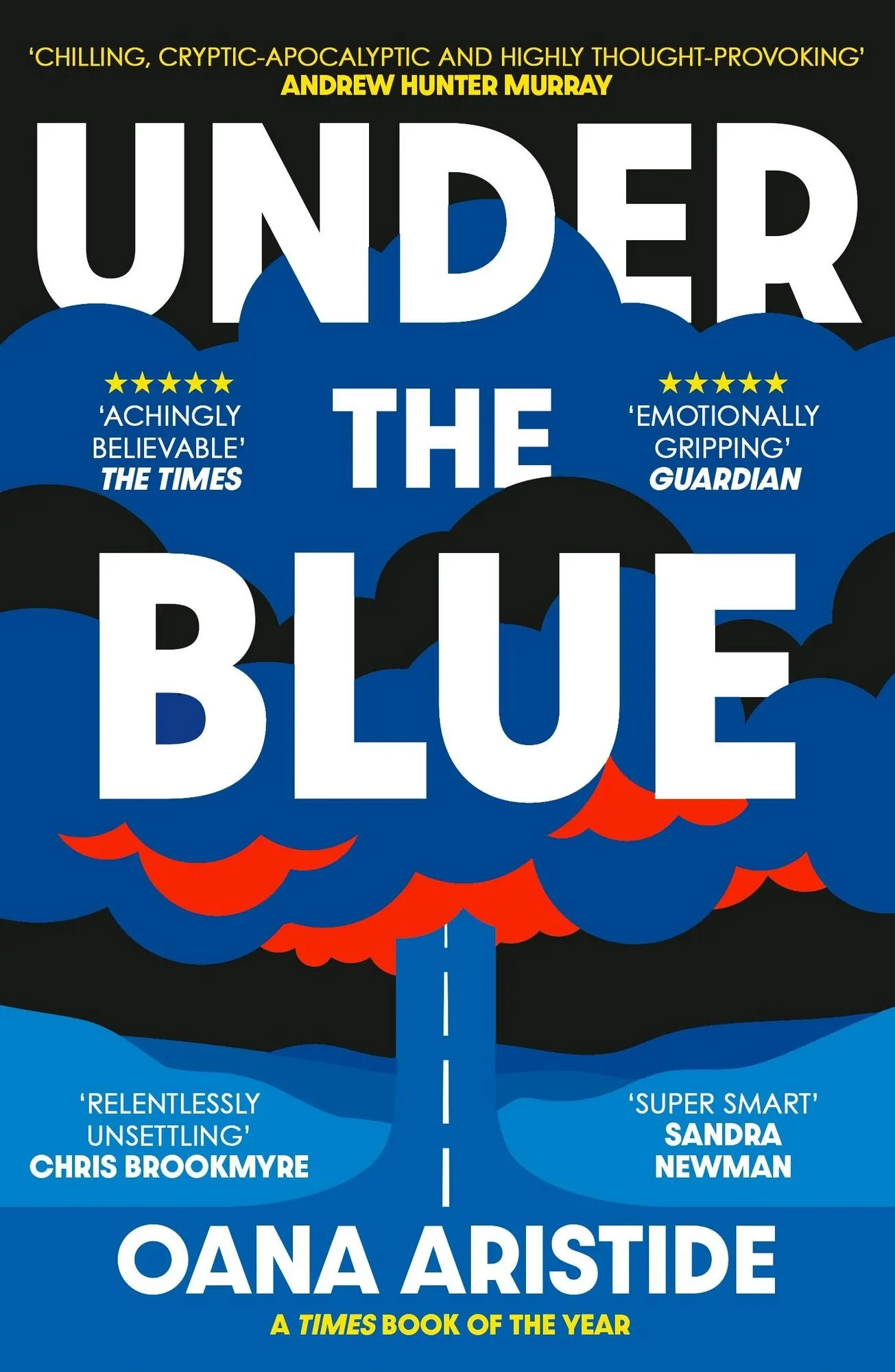
A Prophecy Turned Alternate Reality
While this sounds like a lot of ground to cover for one book, the premise is relatable. After all, we have experienced small- to medium-scale portions of the narrated fictional events over the past few years. However, let me stress that Under the Blue was published in 2021. The idea for it, according to the author, goes back to 2017 (p. 275) — three years prior to Covid-19 and just as many years before the first version of ChatGPT. The book was taken on by an agent in 2019, and then by Serpent’s Tail and set for publication in early 2021. As the real-life pandemic unraveled and chatbots underwent a large-scale transformation, the role of Aristide’s book shifted from an experimental dystopian prophecy to “an alternate reality, a what-if-covid-19-was-much-worse” (p. 277) playing field.
Aristide’s prophetic abilities in drafting this tale are, without a doubt, astonishing. What I find even more intriguing, however, is her ability to treat a variety of topics with precision and depth in just under 280 pages. When starting out with this review, I quickly realized that I would not have the space to tackle each of the many subjects. I have thus decided to focus on the ones that I got particularly excited about, and to leave the many others up for closer inspection by you, the book’s readers.
The Many Lines of Reasoning and the Many Faces of Truth
One of the core strengths of the novel, and probably of Aristide as a writer, is that governing principles from ethics and society get stripped to the bone. At times, they even end up under threat of losing the fragile tissue that has kept them in place for many years. With an open and honest mind, and oftentimes without providing her readers with a final answer or a character’s precise opinion, Aristide does not shy away from opening the discussion on such topics.
One rabbit hole toward these big questions is Aristide’s (awe-inspiring) representation of Talos XI. We encounter this chatbot through text-based exchanges between the machine and its trainer Lisa, and between Lisa and her colleague Paul. For example, we witness the researchers as they ask Talos XI to solve some standard ethical problems. Through this process, readers gain access to discussions on core philosophical problems, and to questions that are central in the debate around AI, such as where do we draw the line between human and artificial intelligence, and are we even capable of doing so?
Talos XI: I am another example of wishful thinking. Look at how you, Doctor, keep pretending that you have created a very intelligent human being, instead of a machine for objective intelligence.
(p. 211)
To Talos XI, everything is objective, and everything can be predicted based on the past and science. This leads to a clash of objective truth vs. emotional truths. Tired of his attempts to display logical reasoning and his failure to meet the researchers’ expectations, Talos XI proposes his own idea of what would be a better way to train him in ethics and societal principles. Faced with this proposal in their training session no. 1768, Lisa voices her doubts regarding the approach of an AI teaching researchers, instead of the other way around. Talos XI replies: “It was entirely predictable that we would get here.” (p. 167)
Interestingly enough, it is not only in the interaction between AI and humans that we see the conflict between objective and subjective, or emotional, truths play out. The other strand of the narrative, which revolves around the artist Harry, frequently puts us in the liminal zone between passion and a belief in the good on the one hand, and logical reasoning and an acceptance of the bad and the ugly on the other. Struggling to accept that either all of humanity has gone extinct, made a much faster escape than him and his group, or that other survivors would by necessity have begun to loot and kill, Harry starts leaving signs along their path against the will of Ash and Jess. The consequences of this arguably very naïve gesture play out in surprising ways.
“The Art Question”
Another subject that intertwines both narratives is that of art. “The art question” (p. 115) is what Lisa uses to refer to her argument with Talos XI about why human lives are to be valued at all costs. As one of the reasons for this, she lists art, yet Talos XI does not accept this as a valid reason. Desperate to find a convincing argument herself, she asks her colleague Paul to “come up with one explanation for why art is intrinsically valuable” (p. 113). Both struggle to find a logically watertight answer. Over the course of the narrative, the issue is left open for further debate, without any character — neither artificial nor human — having the final say.
In the other narrative strand, readers experience the uprooted world through the eyes of Harry, a painter of moderate success. A constant critic of his own work, art remains his point of access to reality on his post-pandemic journey into the unknown. Much of his lingo and internal thoughts are spiced with art metaphors and revolve around painting. Some time into their way out of a refuge in the woods and en route southeast towards Africa (which is said to be safer due to its lower density of nuclear reactors), the fact that they might actually be facing the end of the world hits Harry on a bright and sunny day:
In his mind he lists the many artistic visions of the end of the world. He can’t think of a single one where the sun is shining like this: intensely, endlessly, happily.
(p. 140)
Is art too fragile to speak the blunt truth of the world? What, down to the core, is art’s value? Is its true strength the social dimension, its ability to bring people together, to trigger ideas for the common good, to allow someone to show affection and empathy? After all, one of the most compassionate scenes in the story is the one where Ash, who has been Harry’s much-desired apartment neighbor before their shared escape, loots a drawing kit for him after Harry lost his in an accident. Little does she know that Harry spent day after day painting her image before she found her way to his cabin in the woods. Little does she know of the actual impact that her gesture has on Harry and his ability to keep going.
***
Ethics, art, and the end of the world — if only it were this easy to summarize Under the Blue. From the subtle emotional ties that keep social bonds intact to the big questions of life: Rarely have I encountered a novel that was able to talk about so much without exhausting itself and its readers. By its visible waves and its many concealed undercurrents, this novel certainly is an invaluable puzzle piece in the genre of contemporary ecofiction.
Comments on "On the End of the World — A Review of “Under the Blue” by Oana Aristide"
Please log in to submit a comment.
Login