
Published February 2nd, 2026
Review
Love and Its Many Tints — A Review of Juhea Kim’s “A Love Story From the End of the World”
by Jana Yin
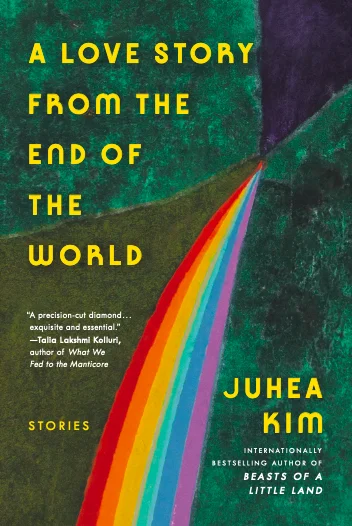
Juhea Kim’s new book, A Love Story From the End of the World: Stories (Ecco, 2025), is a collection of ten short stories that span a spectrum of emotions and human experiences. Her prose, vivid and culturally rich, possesses this quiet gravity. You don’t just read her stories; you drift straight into them and stay there until she lets you go at the final line.
“Biodome,” the first story in the collection, envisions Seoul in a future smothered in yellow dust, so sharply rendered that it feels more like a warning than fiction. The protagonist, who has lived both before and after the biodome era, navigates the narrative with a muted longing, holding onto the memory of a freer world.
History weaves its way through her stories, as seen in “A Woman’s Life in 10 Scenes,” while “Color of the New World” carries with it a gentle intellectual romance deepening the narrative without weighing it down.
“KwaZulu-Natal” traces the life of Rocky, the elephant, set against the pulse of the land itself. Kim includes the culture of the human protagonist not only into the plot but into the language, allowing readers to taste the African soil in every line. This comes through in moments of everyday life, as when the narrator recalls,
Da said Jezus it’s bladdy hot I’m going inside, and just like so he disappeared. And I got so worried leaving the elephant by itself in the bakkie with the sun beating down on his back, but I ran inside chop chop and got a bucket of water and an umbrella.
With sensitivity and depth, she does justice to the bond between people and their beloved animals, while also awakening an awareness of the realities in parts of this world we too often choose not to see.
We can see a cinematic sheen to Kim’s storytelling, the kind that makes every scene unfold in your mind. This book widens the definition of love to offer versions beyond the romantic; each is touched with a quiet ache that lingers after the page turns. A few of the stories leave their endings open, trusting their readers to complete the emotional arc themselves.
The lines from “Older Sister” are both amusing and weighty. The story captures a form of love that can neither be hidden nor openly shown, emerging through seemingly casual moments carrying the story’s tension, revealing how affection, resentment and obligation coexist within sibling relationships.
Kim has a quiet mastery in carrying her stories with grace, choosing, at times, not to name her characters and, at others, to address them through initials, as she does in “The Tree of Life,” subtly engaging the reader’s imagination. In “The Tree of Life,” Kim touches her roots once again by taking us back to Korea. Through the Korean cultural setting, the story probes the darker sides of human relationships and makes us question how we can’t change it even when we know it.
From the collection, “Mountain, Island” is one of the stories that shook me and weighed heavily on my heart. I was particularly struck by the following dialogue:
“Money, power, fame, penthouses, private jets, Cartier Tank watches for each day of the week, a dog collar from Hermès — I don’t even have a dog! — I find these things are all meaningless,” J-Raw carries on, gesturing at their discreetly opulent abode.
“Success doesn’t make you happy. Only being yourself can make you happy ... Just be,” Be finishes, flashing me a dewy smile, before I take the elevator down, down, down to the real world.
Moving between two distinct worlds, the narrative reveals how intricately they are linked, yet how their paths never truly meet. The end is a quiet devastation, leaving the reader with both an injured heart and a fragile sense of hope.
The ninth story, “Notting Hill,” is my personal favourite because it feels so real. You experience everything as if you’re the one living it. Even though it mainly explores love, expectations, misunderstandings, and pain, Kim still adds her subtle reminder about caring for the environment and hoping for a better world through the character — You, who often feels alone and out of place, unable to settle down even for someone you love. Rather than depending on another person for happiness, You ultimately choose yourself.
The final and titular story, “A Love Story From the End of the World,” follows Bada, who longs for love while standing on a seashore in one corner of the world, only to discover it at the very end of it — on a lonely islet near the Arctic Ocean at the North Pole. The story brings the collection to a quiet, reflective close, culminating in the line, “… everything that made up this hard, ugly, broken, and beautiful world where, in the end, absolutely nothing mattered except how much one loved,” offering a resonant and fitting conclusion to Kim’s series of love stories.

Juhea Kim gives voice to the unspoken emotions that shape relationships. Whether between lovers, parents and children, siblings, a boss and a worker, humans and their pets, strangers, or even a fan and their idol, she captures the quiet tensions and affections that often go unnamed.
If you’re willing to read beyond your own bubble, beyond comfort, beyond the neatly curated realities shown by big magazines and powerful people, and you’re ready to truly step into someone else’s life and feel what they feel, then A Love Story From the End of the World will hit hard. In a way that hurts. The heartbreak comes from realizing how much of the world you didn’t see, didn’t know, or chose not to notice before. Once you’ve seen that reality, you can’t unsee it, and you can’t go back to being comfortably ignorant.
1Due to reading the digital copy, no page numbers are given for the quotes.
Comments on "Love and Its Many Tints — A Review of Juhea Kim’s “A Love Story From the End of the World”"
Please log in to submit a comment.
Login