
Published November 9th, 2026
Review
Documenting a Queer Archive — A Review of “Chapal Rani, the Last Queen of Bengal” by Sandip Roy
by Anant
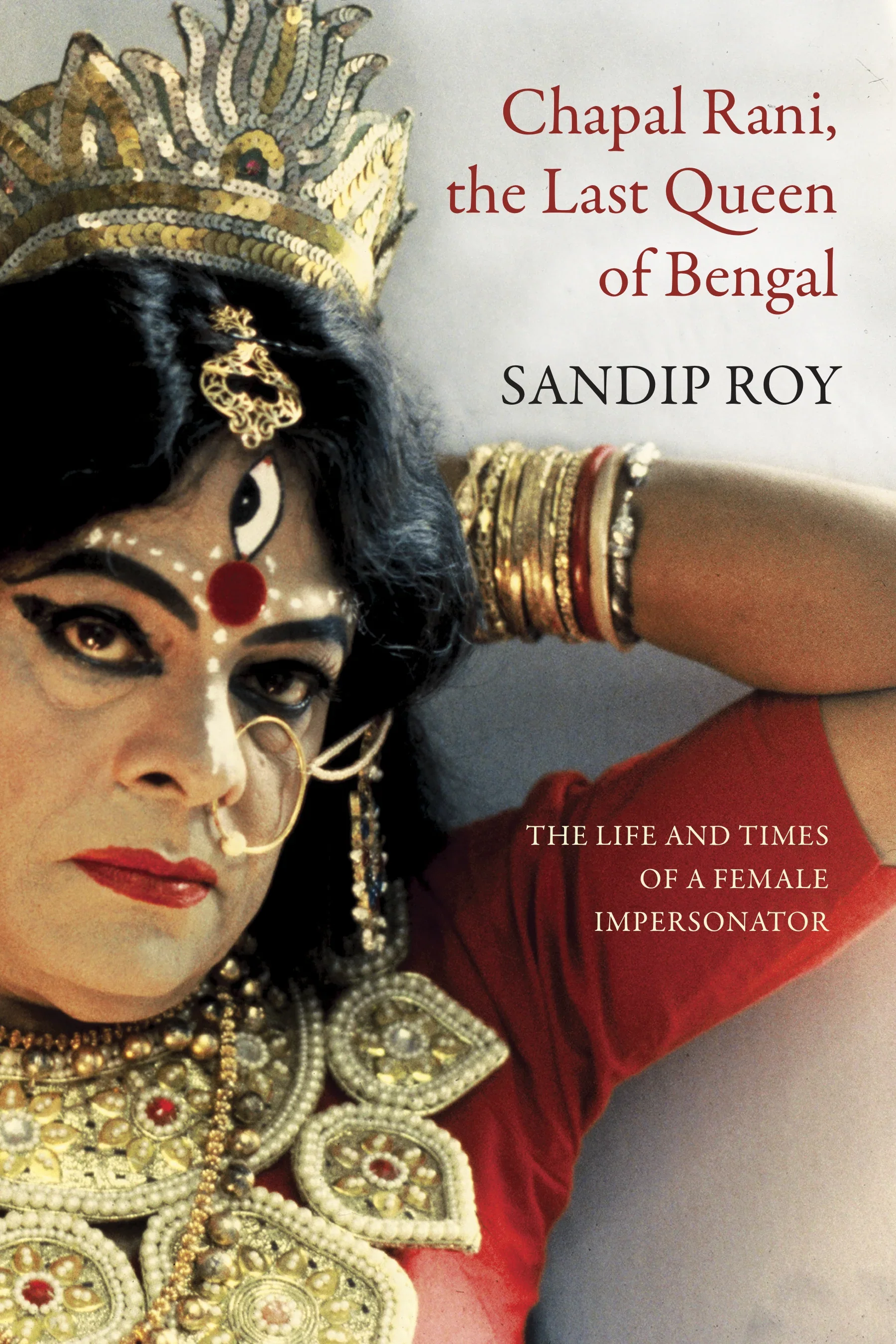
Representations of queerness in twentieth-century South Asian popular culture are few, primarily owing to the hegemonic hold of Victorian morality, intertwined with laws and acts that sought to censure and erase queerness. Sandip Rai’s memoir Chapal Rani, the Last Queen of Bengal: The Life and Times of a Female Impersonator (Seagull Books, 2025) explores the life of Chapal Bhaduri, an icon of Bengali Jatra (folk theatre) in the 1950s. Through his journey, the book takes us into a world of queer survival, desire and relationships across urban and rural Bengal.
***
Sandip’s book follows a slightly different trajectory from most memoirs. Narrated in Chapal’s own voice, the book also incorporates fictional vignettes, placing it in the category of creative non-fiction. Chapal is born into an iconic theatre family, with his mother, Prabhadevi, among the tallest figures in Bengali theatre, patronised by the city’s elites. Prabhadevi looms large in Chapal’s life. A fiercely independent woman whose earnings from theatre built the house in which he grew up, her tragic death at the height of her popularity pushed the family into difficult times and marked Chapal’s entry into Jatra under the name Chapal Rani. Unlike theatre, Jatra was looked down upon by those at the top of the cultural hierarchy, even as it commanded a huge audience in the countryside. For Chapal, it also proved to be a lucrative proposition, and he climbed the ladder of success fairly quickly to emerge as one of Jatra’s leading stars. Thousands would often line up and surround the stage as he performed characters ranging from Razia to Shabri, from a young doe in love with her hero to a vengeful, evil queen.
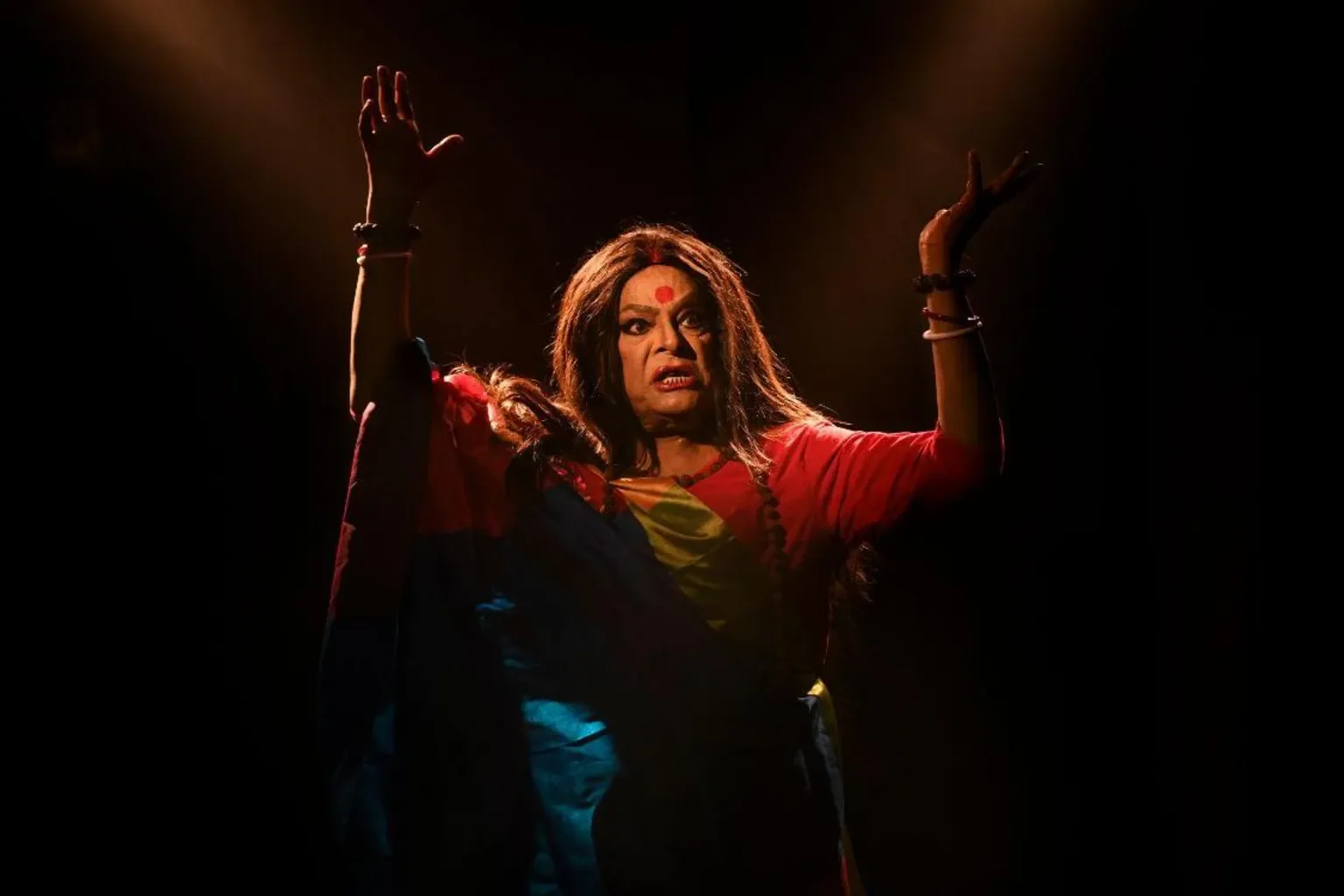
Chapal Bhaduri became famous for enacting women’s roles. In the 1950s, men regularly played female characters, as women were reluctant to travel to the countryside for Jatra performances, which often required weeks away from home. Such prolonged absence from the domestic sphere was frowned upon in a society marked by misogyny and patriarchy. Chapal’s era marked both the end of the tradition of ‘female impersonators’ and the beginning of female actors taking on roles written for women. With the rise of female actors, Chapal was gradually pushed aside, and just when he thought his career was over, came his first reincarnation: he began portraying Sitala Mata, a folk goddess believed to protect people from the deadly scourge of smallpox, on the streets. The money was scarce and the work often stretched into the early hours of the morning, but it became an unlikely anchor for Chapal, providing him with a modest income that helped partially support him as he lived with his sister.
It was here that a chance encounter brought Chapal Rani back into the modern world through a documentary. What followed, as Sandip notes, was the second reincarnation of Chapal Rani, with Chapal travelling nationally and internationally, performing for a very different audience and participating in panels on queerness, often reluctantly, as the author notes. Unlike Chapal, many others were not as fortunate; they faded into oblivion, some dying in penury.
The book makes a compelling attempt to capture the interiority of this act of impersonation: what did it take for Chapal Bhaduri to become Chapal Rani? This transition went beyond the layers of cloth that Chapal inserted inside his blouse to appear as a woman, or the gorgeous wardrobe he had collected while travelling through various cities. By his own admission, he would always change in a separate room, away from the prying eyes of others, for the transformation required a shift in the mind and not merely in attire. We are left with a conflicted picture of Chapal’s inner world as he navigated this transition. Did he feel like a woman when playing a woman’s role? One cannot say for sure, but he certainly emerged as Chapal Rani rather than Chapal Bhaduri. His popularity was cemented by men who wanted him to come home with them, believing him to be a woman rather than a man. He attracted not only the adulation of men who mistook him for a woman, but also that of men who knew he was merely playing a woman. Queer desire, too, followed Chapal, though he was not particularly enamoured of it. He would tear up letters written by men attracted to Chapal Bhaduri rather than Chapal Rani.
Chapal Bhaduri also had a partner whom he met in his late teens, and their relationship lasted for a few decades, even as the other man, who remains unnamed, married and had children. As the author notes, they would often meet during the monsoons to “quench our pent up physical longing for each other" (p. 284), as this was the lean season for Jatra. Chapal’s decline in the Jatra world left him without a home of his own, and he eventually moved in with his partner and his wife and children. He took charge of the kitchen, and the partner’s home became a safe haven for Chapal, until it no longer was. The end of their relationship also marked the loss of a precious historical archive, as many of Chapal Bhaduri’s photographs and letters were lost when he moved out.
Today, Chapal lives alone in an old-age home in the same iconic neighbourhood of North Kolkata where he was born. As a boy who loved looking at himself in the mirror, he now lives in a room that does not even have space for a full-length mirror. His nieces visit him often, but one cannot help wondering how Chapal’s life might have unfolded had he not been attracted to men and had instead chosen to marry. Queerness, after all, often deprives us of the ability to draw upon traditional kinship networks in societies marked by homophobia.
Chapal Rani’s story has a deep subversive potential, even as Sandip notes that Chapal does not identify with the modern queer movement. His vehement assertion that he belongs to the ‘first gender’ and not the ‘third’ appears to stem, at least in part, from his explicit disavowal of any association with transness. Yet this distance from the language of the contemporary queer movement does not amount to an alienation from queerness itself. It is, instead, located in the convergence of the different marginalities that came to define Chapal’s life: being told that he would have realised his potential as an actor had he been born a girl; the lack of recognition accorded to Jatra in comparison to theatre; and his attraction to men. Acknowledging one’s own marginality, after all, might mean relinquishing whatever little power a marginalised person possesses. One also wonders how much of the lexicon is lost in translation from Bengali to English. As Sandip himself notes, Chapal’s preferred language of conversation is Bengali, while the book is written in English. We therefore find no vernacular terms for queerness in the book. The book’s strength lies in its ability to weave a universe in which Chapla rules and fails, but continues to survive. And his survival is iconic.
Comments on "Documenting a Queer Archive — A Review of “Chapal Rani, the Last Queen of Bengal” by Sandip Roy"
Please log in to submit a comment.
Login