
Published September 28th, 2026
Review
Collaboration and the Fragility of Communication — A Review of “Thaumatropes” by Sophia Popovska and Jonah Howell
by Srijani Mitra
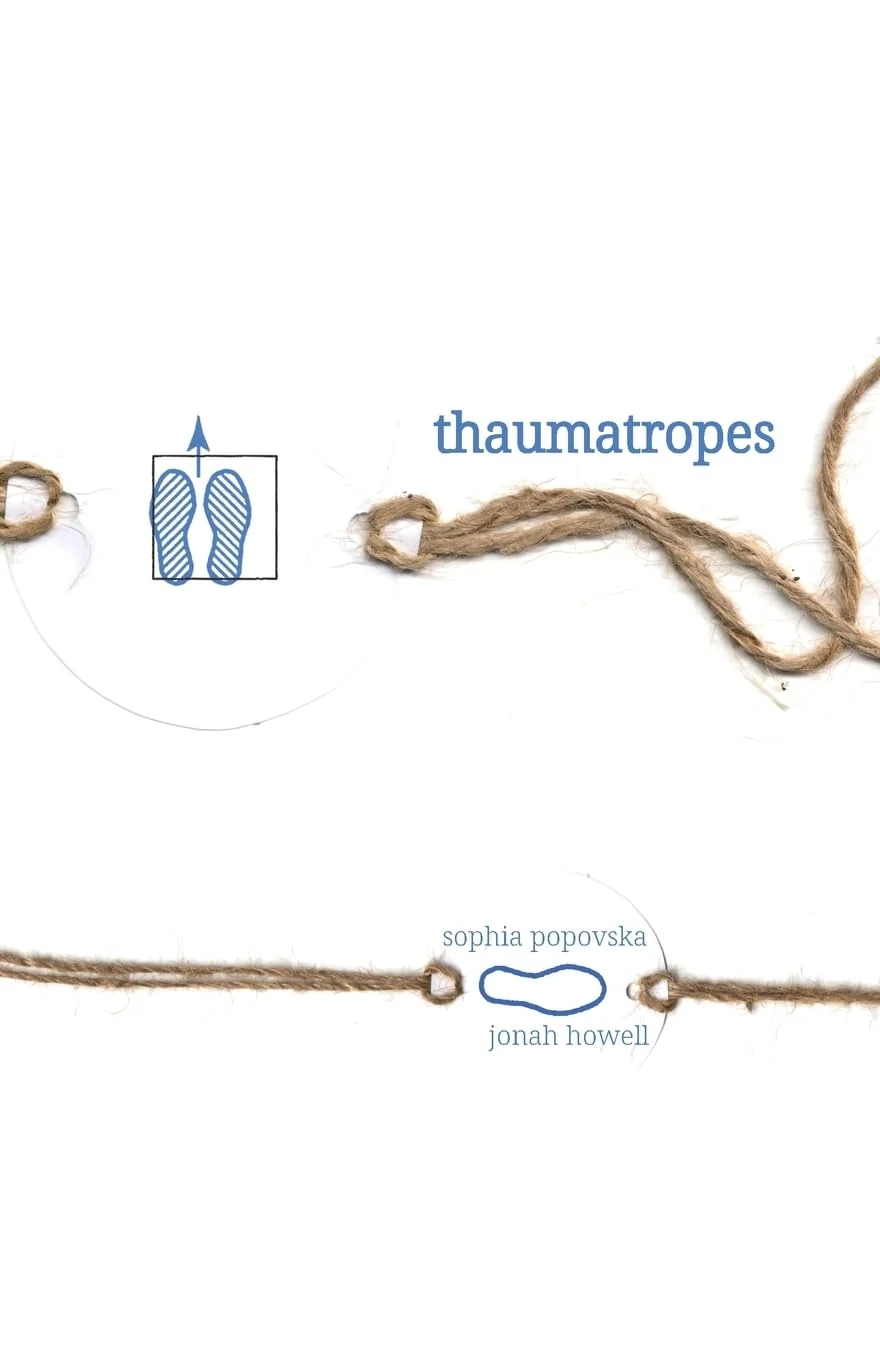
What happens when poetry becomes a shared journey? In Thaumatropes (Newcomer Press, 2023), poets Sophia Popovska and Jonah Howell explore the possibilities of collaborative authorship, weaving together fragments of memory, myth, and intimate correspondence. Moving between associative lyricism and structural experimentation, the collection invites readers to reconsider the fragile boundaries between language, identity, and connection. Popovska, a writer, translator, and Editor-at-Large at Asymptote Journal, joins Howell, author of the poetry and essay collection Empathology (BHN Books, 2019), in creating a work that explores the spaces between selves and the shifting perspectives through which we attempt to encounter one another.
***
“Maybe the real novel is letters to you” (p. 5). This epigraph lingers over Thaumatropes not as a guiding principle but as a question the book keeps circling around without settling. What begins as an intimate epistolary exchange between Sophia and Jonah gradually dissolves into something far less contained. It is almost like a dispersed, recursive text where the address persists, but its object becomes increasingly unstable.
The opening letters are crucial, not only for their emotional immediacy, but for the way they establish the book’s central preoccupation with embodiment and mediation. Memory here is incorporative rather than reflective. For instance, consider the line “I walk on your legs, stretch your arms, speak with your tongue,” (p. 9). This collapse of self and other establishes an unusual desire for fusion that the rest of the collection repeatedly complicates. Even within the letters, connection is already under strain. Language feels provisional, almost dangerous, as if “a word askew will pull apart the tender threads” (p. 11). What follows can be read as the aftermath of this instability: a poetics that moves through fragments, systems, and symbolic overload in search of a form capable of holding that initial intensity.
In “Book of Beginnings (Fragments),” Popovska draws on biblical figures such as Lazarus, Maria of Magdala, and Judas. It is not to anchor the text in narrative, but to unsettle identity itself. Lazarus emerges “(...) neither / Alive, nor dead” (p. 13), caught in a state that resists resolution. These poems are less concerned with resurrection as an event than with its aftermath as the disorientation of return and the persistence of wounds. The language is often striking in its tactile imagery and immediacy — “The medicine of movement / A pair of eyes relaxing / Into mine” (p. 14) — yet it also leans heavily on a symbolic vocabulary comprising the elements of blood, desert, and stars. At times, this produces an almost liturgical ambience, at others the repetition risks dimming the force of individual images.
This tension between intensity and saturation carries into one of my favourite poems in the collection, “Oracular Revisions: Chiaroscuro”. The title itself points to the beautiful contrast of light and shadow, the historical concept of chiaroscuro, however the poems resist such clear delineation. In “The One Where Lazarus was Late,” revelation is “Missed by a hair,” (p. 33), deferred into uncertainty. In “The One Where Eurydice Finds Orpheus,” the anticipated moment of recognition becomes a scene of near-contact where the phantom arrives, speaks, but language fades. The poem accumulates gestures such as “A sliver of a chance” (p. 34) and “a promise / (of completion)” (p. 34) only to undercut them with slight hesitation. What emerges is not clarity but a suspended recognition, where meaning flickers like light without stabilizing to a ground. The sequence is effective in staging this instability, though its reliance on abstraction occasionally diffuses its emotional precision.
Howell’s sections introduce a different kind of density. In “Pentagrammaton: The Station,” the train station becomes a site of recursive temporality, where figures repeat across time and space folds in on itself. The recurring train whistle, already present in the letters, takes on a more formal role here, marking transitions that never fully resolve. Similarly, “Lou: Symmetriad” constructs an elaborate system of mirrors and numerical patterns. The central image of “Three mirrors, (…) / In each mirror, three men,” (p. 57) generates a proliferating logic of self-division. Identity becomes something distributed and endlessly refracted. While this formal rigor is compelling, it can also feel hermetic at times. The poem’s internal logic is meticulously maintained, but its stakes remain opaque.
The interplay between Popovska’s associative lyricism and Howell’s structural recursion is one of the book’s defining features. At times, the two modes resonate,particularly in their shared use of recurring motifs. Trains, mirrors, birds, and deserts move across sections, creating a loose network of associations. The bird, for instance, appears in multiple contexts, as a distant figure in Howell’s station poems and as a fragile presence in Popovska’s “Natural Artifacts.” These repetitions do not coalesce into a unified system, but they do generate a sense of internal echo, as if the text were listening to itself.
Shorter pieces often provide moments of relative clarity. In “You ◊ I,” the juxtaposition of cemetery and station distills the book’s larger concerns into a few precise gestures: “‘I love you,’ ripped out of the air by a passing train” (p. 29). Here, the interruption is immediate and legible, language is both uttered and erased in the same moment. Similarly, parts of “Thaumatropes: Avista” return to the titular metaphor more directly. The flickering image captures the book’s underlying logic. It is the same recurrence of meaning emerging from the tension between states that never fully merge.
Elsewhere, the text leans into excess. Sections like “Glossary of Inglorious Fevers” and “Transatlantic Accent: Noumenopathy” push the density of imagery to a point where individual elements begin to blur. The language accumulates “ferrous shore” (p. 76), “Afar a sandbar, catatonic.” (p. 72), and “nacreous oyster” (p. 77) without always producing further differentiation. This can create a kind of textual saturation, where the reader remains within a consistent tonal register without clear modulation. The effect is immersive, but also demanding a mode of reading that is less interpretive than absorptive.
What remains consistent throughout is the book’s concern with mediation. Letters, mirrors, stations, optical devices are not incidental motifs but structural elements. The thaumatrope, in particular, offers a useful frame of two images held together through rapid alternation, producing the illusion of unity. Thaumatropes repeatedly enacts this mechanism, placing fragments in proximity without resolving their differences. The result is a text that resists synthesis. Connection is desired, approached, but never fully achieved.
The closing sections do not offer resolution so much as continuation. The final poems return to disappearance, partial encounters, and the persistence of address without guarantee of response. If the letters at the beginning suggest the possibility of a shared language, the rest of the book demonstrates how fragile that possibility is. Communication becomes an ongoing process of approximation, interruption, and reconfiguration.
Thaumatropes is, in this sense, less a collection than a sustained experiment in relation between selves, between forms, between fragments that refuse to settle. Its ambitions are evident, and its execution is uneven at points, particularly where density overtakes differentiation. Yet its commitment to exploring the limits of language and perception gives it a distinct presence. It asks not to be resolved, but to be held in its constant flicker.
Comments on "Collaboration and the Fragility of Communication — A Review of “Thaumatropes” by Sophia Popovska and Jonah Howell"
Please log in to submit a comment.
Login