
Published April 13th, 2026
Review
Between Control and Insanity — A Review of “The Coin” by Yasmin Zaher
by Luisa Angermann
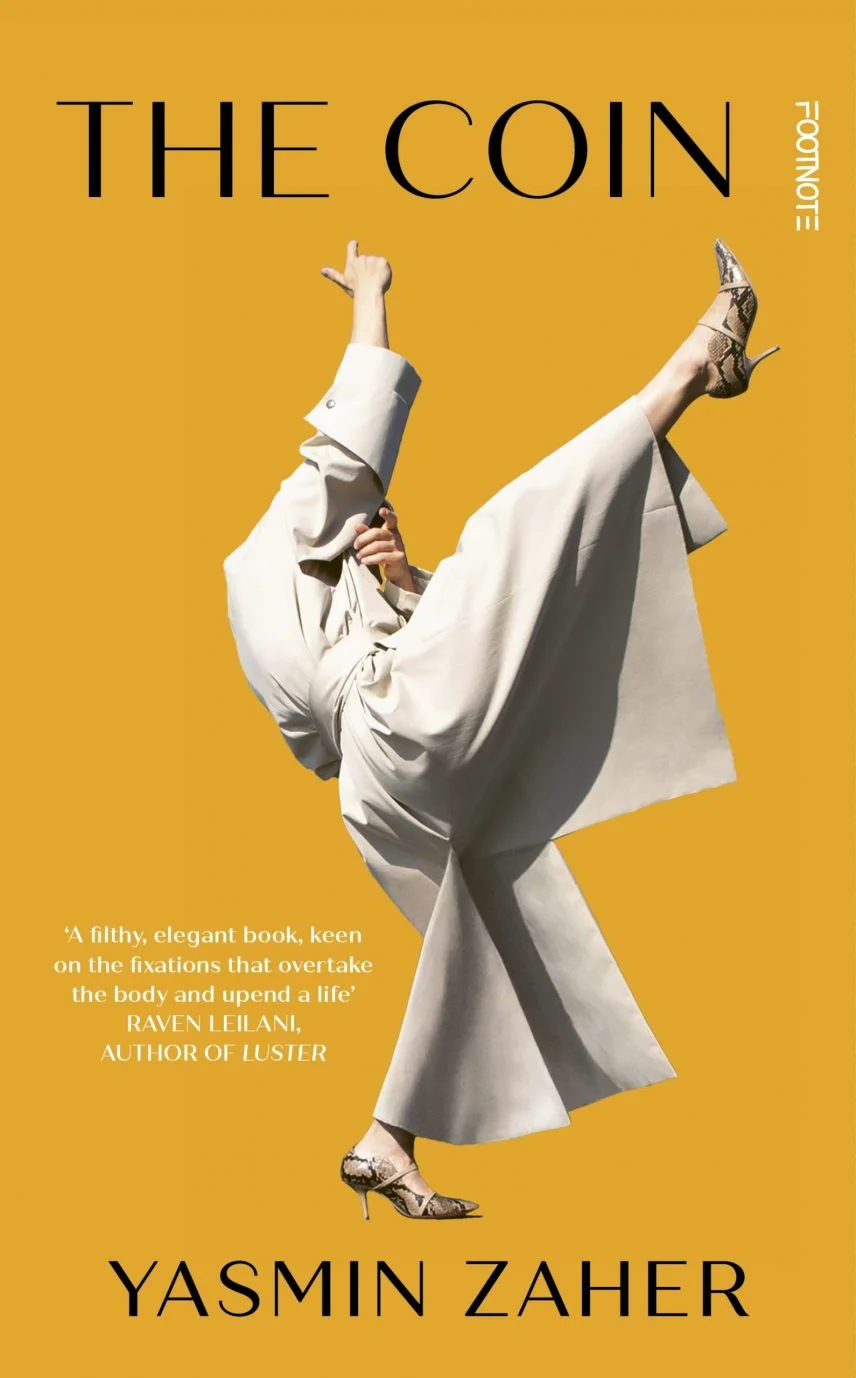
Yasmin Zaher’s debut novel The Coin (Catapult, 2024), winner of the 2025 Dylan Thomas Prize, follows a young Palestinian woman in New York City who is yearning for freedom and control over her life. However, she struggles with neurotic behaviour and a past waiting to be processed, shaped by a Palestinian heritage and a childhood in an indifferent America. Readers are presented with a dichotomy between control and insanity, cleanliness and dirt, luxury and poverty — all held together by one item: the coin.
The unnamed main character is obsessed with cleaning and getting rid of dirt — the dirt of the city but also the dirt of her past turning up in every corner of her life. There is one unreachable part of her body where trying to scrub it off does not help: the coin.
I was convinced that it was the cause of everything, that need for a tight grip on the universe, and especially the dirt. I was also afraid that maybe the coin had rusted, over the years, and was decomposing inside of me, or maybe it was multiplying, a small stack, three or four shekels, which, when I was a kid, was enough to buy a can of Coke. (p. 49)
She knows that the coin was placed there in her childhood when she swallowed it and has — at least metaphorically — stayed ever since, but it has reached her conscious mind only recently. While she wants to grab the coin and get rid of it, it also provides some kind of safety. Readers might fear that if the coin leaves its place, hell will break loose. All this presents the coin as something traumatic to be unravelled on the one hand but as a protective shield from precisely that on the other hand. Why the image of the coin, closely related to money, has been chosen by the author remains up to interpretation.
As the story progresses, the unnamed character gives up on her cleaning-obsession and instead decides to become one with nature in her own flat. It becomes clear that the novel can be associated with the growing genre of weird girl fiction, influenced by works such as Ottessa Moshfegh’s My Year of Rest and Relaxation. In an interview for the Inklings Book Club podcast, Zaher herself calls Moshfegh’s and her own novel soul sisters, having read My Year of Rest and Relaxation after writing The Coin. Locking herself up in her flat, Zaher’s protagonist seems to spiral down a road to insanity, but at the same time she also seems more connected to herself and the pain she carries. She practices intuitive, secluded, nature-led living in the middle of New York City. By deciding to let go of the control she used to get from cleaning, she confronts her struggles. Thoughts such as “the curse was also the key” (p. 214) show the character’s awareness of the need to unravel her life.
Besides an on-off relationship shaped by dependency with Sasha and a loose friendship with a man known as “Trenchcoat,” she leads a socially isolated private life. In her job as a middle school English teacher though, she has a strong impact on her students’ lives. She teaches them what she deems as important, sometimes using unconventional methods. Favouring specific students over others, building deeper relationships with them and consciously lying to her class lets her tendency to overstep moral boundaries shine through. Her moral ambiguity is not a secret neither to the reader nor to the character’s environment though. Several opinions are voiced throughout the novel that might be placed in the morally grey area. She not only puts people in opposing categories such as dirty and clean, good and evil; the character herself is the prime example of these dichotomies. Also, she is brutally honest in her views of the world and other people but never fully discloses some essential parts of herself.

Zaher’s style of writing helps to portray the novel’s protagonist as exactly that: ambiguous, slightly mysterious and unattainable but also straightforward and blunt in her views. The main character seems to lack emotions, making it hard to empathize with and placing the reader as a spectator on the outside. Nevertheless, that position accurately reflects how the character seems to be perceived by the people around her. The novel sometimes reads like a random sequence of things happening to the young woman that might be hard to fit into the big picture of her character, but on closer inspection, the big picture is composed of all those. While the character slowly seems to process her life by recounting several seemingly unrelated childhood memories, sometimes traumatic events are casually dropped, making readers’ jaws drop. Another interesting aspect is the fact that the narrating protagonist sometimes directly addresses a mysterious “you” — it remains unclear even to herself whether she talks to some long-lost or locked-up part of herself, to the reader or to no one in particular: “I wanted to know if you were a figment of my imagination or something inherited.” (p. 92)
Political insights about Palestine, America and life between the two places and cultures are also woven into the novel. The protagonist mentions and judges America’s indifference towards the rest of the world, recounts family history about her grandparents whose property was disowned in 1948 and states that her family did not have a country. Also, the general uncertainty whether disclosing one’s Palestinian identity to strangers will lead to full support or immediate rejection is portrayed. Reflections on the character’s race, identity and her role as Palestinian in New York and Paris might be influenced by the author’s own experience. Zaher is Palestinian and, according to an interview with The Guardian, has lived in all settings of the novel herself. Subtle and direct questioning of power relations between people of different ethnicities, gender or wealth can be found throughout the novel. These aspects shape its political tone that adds to the main storyline of the rather self-centred protagonist.
The Coin is for readers of weird girl fiction who are also interested in social and political power relations. If you want to experience the reality of a Palestinian woman in the US and get a glimpse into her deep-rooted trauma, whose true nature is left to you to interpret, Zaher’s renowned work might be the ideal next read.
***
Disclaimer: The author has received a free review copy. The views and opinions of this review reflect their honest assessment of the book.
Comments on "Between Control and Insanity — A Review of “The Coin” by Yasmin Zaher"
Please log in to submit a comment.
Login