
Published May 25th, 2026
Profile
Lore Segal — A Life in Sentences
by Ayesha Usman
There are writers who shout, writers who dazzle, writers who conquer rooms. And then there are writers like Lore Segal — who sit quietly, observe everything, survive history, and turn a life into sentences so clean they feel almost weightless. Almost.
Lore Segal has never been a loud presence in American literature, and yet she has been an enduring one. Born in Vienna in 1928, displaced by fascism, reshaped by exile, and sharpened by language, Segal’s work spans more than seven decades. She wrote novels, short stories, essays, children’s books, and translations — and, in doing so, quietly carved out one of the most honest literary voices of the 20th and early 21st centuries.
This is not a story about a literary celebrity. It is a story about survival, precision, humour, and how a woman turned the experience of being out of place into an art form.
Vienna, Before the Leaving
Lore Segal was born Lore Groszmann in Vienna, into a middle-class Jewish family that valued culture, education, and conversation. This was a city of music, cafés, intellectual life — a place where language mattered, and where a child could grow up surrounded by words before she ever learned their power.
But Vienna in the 1930s was also becoming increasingly dangerous for Jews. The Anschluss in 1938 changed everything. Overnight, the city that had once been home became hostile terrain. Segal was 10 years old when she was sent away through the Kindertransport, a rescue effort that brought Jewish children from Nazi-controlled territories to safety in Britain.
After being separated from her parents during the Kindertransport, Segal never again returned to the family life she had known in Vienna although she succeeded in getting her parents to England. Her father, however, died before the end of the war, while her mother survived, and the two later lived together again.
This rupture — sudden, bureaucratic, final — would become the emotional and moral axis of her writing. Segal rarely dramatized trauma. Instead, she returned to it obliquely, through understatement, irony, and a voice that refuses sentimentality. Loss, in her work, is not theatrical. It is administrative. It arrives via letters, documents, and arrangements made by adults who believe they are doing the right thing.
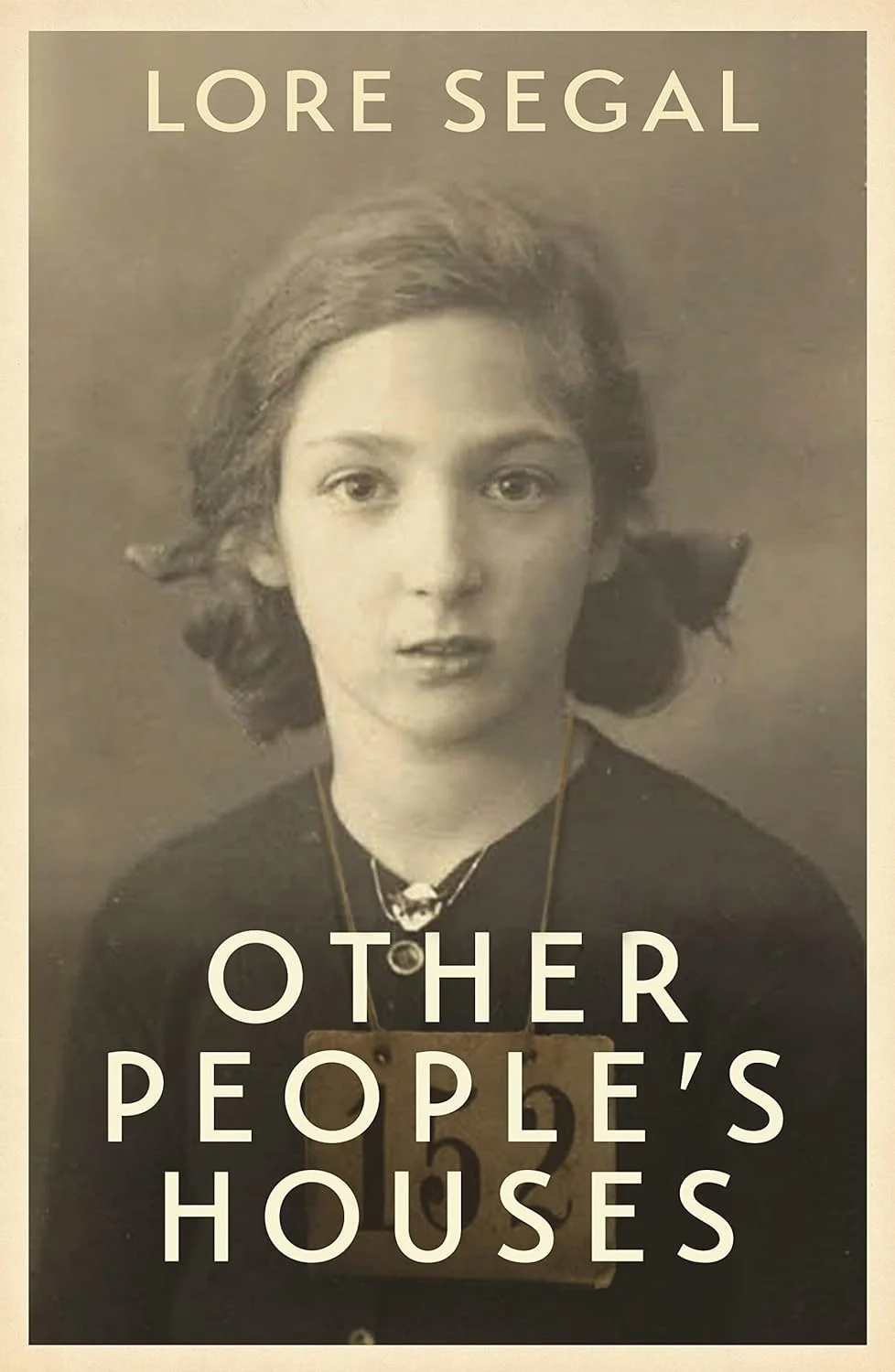
Decades later, she would write about this experience in Other People’s Houses (Harcourt, Brace & World, 1964), a book that remains one of the most unsparing accounts of childhood exile ever written.
England: Becoming Someone Else’s Child
In Britain, Segal moved through a series of foster homes — “other people’s houses” — each with its own rules, expectations, kindnesses, and cruelties. She was safe, but she was not at home. She was grateful, but she was also invisible.
The book that emerged from this experience is remarkable not because it pleads for sympathy, but because it refuses it. The narrator does not rage. She observes. She learns how to adapt, how to please, how to become useful. She learns, above all, how to translate herself.
This instinct — to translate, to mediate between worlds — would later define Segal’s career not only as a writer, but as a translator. Language, for her, was never fixed. It was always provisional. Always borrowed.
England gave her safety, education, and the English language. It also gave her an early lesson in what it means to belong nowhere entirely.
America, or: The First Reinvention
After the war, Segal emigrated first to the Dominican Republic and then to the United States. America was not a return; it was another beginning. She studied, married, had children, and began writing seriously in a literary culture dominated by men and postwar confidence.
Her first novel, Other People’s Houses, was published in the United States to critical acclaim. Reviewers noted its restraint, its moral clarity, its refusal to manipulate the reader’s emotions. It was an unusual debut — quiet, European in sensibility, and almost stubbornly unsensational.
Segal did not write like an immigrant eager to assimilate. Nor did she write like a refugee demanding recognition. Instead, her writings render her as someone deeply suspicious of belonging as a concept.
This suspicion seemed to sharpen over time.
Style: The Art of Saying Less
If there is one thing critics consistently note about Lore Segal’s writing, it is her style. Or rather, her anti-style. Her sentences are clean, direct, and deceptively simple. She avoids metaphor when it risks ornamentation. She distrusts emotional excess. Humour, when it appears, is dry, precise, and often devastating.
This clarity is not accidental. It is ethical.
Segal once remarked that she disliked writing that tries to persuade the reader what to feel. Her work presents situations, people, conversations — and leaves the moral labour to the reader. This is especially evident in her later fiction, where the drama often lies not in what happens, but in what is not said.
In a literary culture that often rewards spectacle, Segal practiced restraint as a form of resistance.
Translator, Listener, Mediator
Alongside her original work, Segal was an accomplished translator; for instance, she translated the fairy tales collected by the Brothers Grimm into English. Translation suited her temperament. It required attentiveness, humility, and a willingness to disappear behind another voice.
But translation also reinforced her belief that language is never neutral. Every sentence carries history. Every word choice is a decision shaped by power, context, and loss.
This sensitivity to language infuses her fiction. Characters misunderstand one another not because they are foolish, but because words fail. Conversations slide sideways. Meaning arrives late — or not at all.
Her First American: Love and Dislocation
Published in 1985, Her First American (Knopf) is often cited as Segal’s most accessible novel. It tells the story of Ilka Weissnix, a German-Jewish refugee, and her relationship with Carter Bayoux, an older African American intellectual in postwar New York.
The novel is about love, but it is also about asymmetry — of power, of belonging, of historical weight. Ilka and Carter are both outsiders, but not in the same way. Their differences cannot be smoothed over by affection.
What makes the novel remarkable is its refusal to sentimentalize this relationship. Segal allows discomfort to remain unresolved. Cultural misunderstandings are not neatly explained away. Love does not redeem history.
Shakespeare’s Kitchen and the Late Voice
In her later years, Segal wrote some of her most daring work. Shakespeare’s Kitchen (New Press, 2007) is a short novel about ageing, friendship, illness, and the indignities of the body. It is also about endurance — specifically, women’s endurance.
The novel’s protagonists are elderly women living in Manhattan, negotiating doctors, memories, resentment, and loyalty. There is no nostalgia here. Ageing is not softened. It is inconvenient, absurd, and sometimes funny.
Segal’s late work confronts mortality without drama. Death is present, but it is not the climax. Life continues around it, stubbornly ordinary.
This refusal to turn ageing into either tragedy or triumph is radical in its own quiet way.
Essays, Honesty, and the Refusal of Performance
Segal’s essays — many published in The New Yorker, The New York Review of Books, and other literary venues — offer insight into her intellectual discipline. She writes about writing, about memory, about ethics, about what it means to tell the truth on the page.
She is suspicious of confession as performance. She distrusts the idea that suffering automatically grants authority. Experience, she insists, must be worked through — not displayed.
This stance has made her something of a writer’s writer: deeply respected, quietly influential, and often under-celebrated.
Being a Woman, Being a Writer
Segal came of age in a literary world that did not make space easily for women, especially women who refused to package themselves as symbols. She was not a spokesperson. She did not brand herself as a survivor. She did not explain herself.
And yet, her work is profoundly feminist — not because it announces itself as such, but because it insists on women’s interior lives, moral complexity, and intellectual seriousness.
Her female characters are not inspirational. They are alert.
Legacy: Quiet, Unmistakable
Lore Segal lived into her nineties, continuing to publish, think, and speak with clarity well into old age. Her longevity was not merely biological — it was artistic. She remained relevant because she never chased relevance.
In an era obsessed with urgency, Segal offers slowness. In a culture addicted to spectacle, she offers attention. In a literary marketplace that rewards noise, she offers sentences that hold.
She reminds us that literature does not have to shout to endure.
Reading Segal in a Time like Ours
In a world of forced narratives and curated identities, Lore Segal’s work feels newly necessary. She shows us how to live with fragmentation without turning it into branding. How to tell the truth without exhibitionism. How to write without lying.
Her books do not beg to be loved. They ask to be read carefully.
And that may be their greatest gift.
Lore Segal wrote a life not in declarations, but in sentences. And those sentences are still with us.
Disclaimer: AI has been used for research, spelling and grammar consultation. The author is responsible for the verification of any AI-informed modifications.
Sources
https://www.theparisreview.org/blog/2019/06/25/the-impossible-life-of-lore-segal/
https://www.thenation.com/article/culture/lore-segal-obit-essay/
https://www.washingtonpost.com/obituaries/2024/10/09/lore-segal-dead/
https://www.literaryladiesguide.com/author-biography/lore-segal/
https://www.lbi.org/events/lore-segal-and-uri-berliner-in-conversation/
https://www.nybooks.com/articles/2024/02/08/isnt-it-interesting-ladies-lunch-lore-segal/
Comments on "Lore Segal — A Life in Sentences"
Please log in to submit a comment.
Login