
Published July 18th, 2026
Profile
Jack Kerouac — The Restless Writer Who Put America on the Road
by Patrichia Dcruze
When America embraced suburbia, routine, and the comfort of stability after WWII, one writer was diving into jazz, highways, and mysticism, the rawest experience. That writer was Jack Kerouac. With a notebook and a head filled with jazz rhythms, Kerouac told stories, but more importantly, he captured movement. He became the emotive voice of the Beat Generation, transforming American literature and living and writing as he wanted.
Early Life: A French-Canadian Childhood in Industrial America
Jack Kerouac’s original name was Jean-Louis Lebris de Kérouac. He was born on March 12, 1922, in Lowell, Massachusetts. His town was very poor, and it was constructed by immigrant workers, along with a mill that was run by Catholic immigrants. Both of Kerouac’s parents were French-Canadian. Because of this, he grew up learning a variety of French called Quebecois. He only learned English when he started going to school. Because of this French-English background, Kerouac’s prose writing had a lot of unnatural rhythms and a strong sensitivity to a voice.
Lowell helped shape his imagination. The city brought together factories, churches, and working-class struggles, and Kerouac felt, for the first time, the duality of belonging and isolation. A death that affected him greatly from his early years was the passing of his older brother, Gerard, which remained with him and, in his later years, became part of his reflective writing. These formative years, religious beliefs, loss, and the quest for purpose in life would resonate in virtually all of his writings, even those that only seemed to be about journeys or escapades.
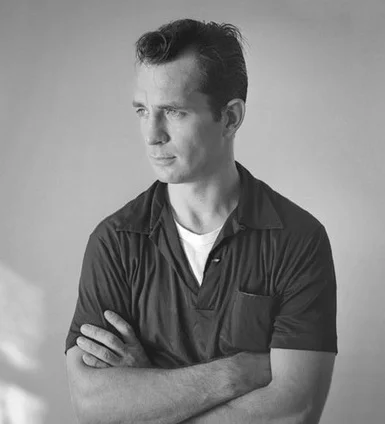
Columbia University and the Birth of the Beat Circle
Jack was awarded a football scholarship to Columbia University in New York City due to his athletic talent. However, an injury cut short his sporting aspirations. Despite this setback, New York proved to be a more significant opportunity for him — one that would be of literary and social consequence. At Columbia, he encountered young writers Allen Ginsberg and William S. Burroughs, who, like him, were disenchanted with the dominant culture of the post-war years. The spectrum of their conversations included philosophy, arts, crime, psychology and spirituality — the foundation of the Beat Generation.
Even though Jack Kerouac did not get his degree, his New York years were spent in all the best places: libraries, jazz bars, and engaging in after-hours talks about art and the
possibilities of freedom. His writing had to be alive, immediate, and raw to be true, not perfected to be lifeless and dull. The friendships he had during this era became the basis for some of his best literary creations.
Life on the Move: Work, Travel, and Searching
Throughout the 1940s, Jack Kerouac travelled through the urban and rural US and Mexico, where he held various jobs, even working as a merchant seaman. These travels were not aimless. Jack was collecting material for a new American literature that was based on movement, not the traditional literary focus on stasis.
Kerouac filled his notebooks with his observations, memories, and conversations with jazz musicians, spiritual seekers, and freight train riders at roadside diners. For him, travel was physical and philosophical. He was seeking the truth in a culture he saw as increasingly spiritually devoid and materially obsessed. This unease between modern conformity and the open road became the primary emotional conflict in his work.
On the Road and a Literary Earthquake
After years of rejections, Kerouac’s defining work, On The Road (Viking Press), was published in 1957, though it was originally written in 1951. The book draws on his travels with his friend Neal Cassady, describing journeys across America emboldened by jazz, friendship, and the need for experiences. The publication changed American literature forever.
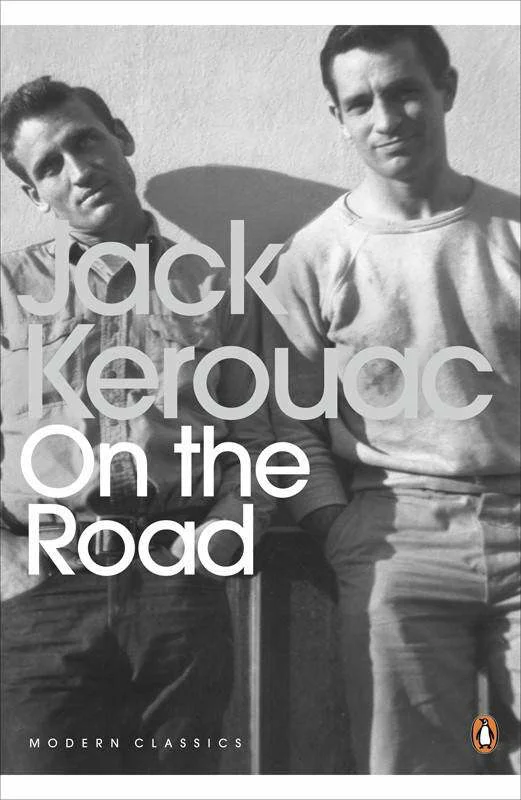
The novel gained attention for both its subject matter and its style. Using what he called “spontaneous prose,” Kerouac tried to describe and write down the thoughts and feelings as they came, without expensive editing. The sentences were influenced by the quick and caring style of bebop jazz, and they were careless, rushing forward with uncontrolled and breathless energy. This style gave the readers the feeling of an unpolished, raw, and naked voice, which was something that traditional prose was always missing.
Although several critics described the book as disorganised, young readers celebrated it as an expression of liberation. The book also became a cultural chronicle and an early defining voice of the counterculture of the 1960s.
Beyond the Highway: Spirituality and Experimentation
Kerouac’s professional life encompassed much more than one book. In The Dharma Bums (Viking Press, 1958), he began to explore Buddhism, along with mountain climbing and meditation, which indicates his deepening concern with the quest for a spiritual awakening. The writings from this time period show a practitioner of the art attempting to balance the ecstasy of the journey with a desire for tranquillity.
He also wrote poetry in great volume while experimenting with the rhythms of jazz and the American version of the shortness of haiku. His poetry examines commonplace phenomena, such as rain, streets of cities, and faces, which he considered moments of insight. For Kerouac, poetry and prose were the same; both were forms for the capture of immediate experience.
Fame, Pressure, and Personal Decline
The rapid success of On the Road almost overnight made Kerouac some kind of celebrity, but he largely shunned the spotlight. People interviewing him made him a face of the counter-culture movement, ignoring the deep artistic expression he felt in his work. This long-standing disconnect, along with alcohol, took its toll on him.
In subsequent writings like Big Sur (Farrar, Straus and Cudahy, 1962), Kerouac wrote openly about fatigue, paranoia, and the psychological toll of being considered a celebrity. The formerly idealised highways grew lonely. His writing from this stage is more shadowy, reflective, and self-analytical, portraying a man contending with the legend that surrounded him.
Death and Enduring Legacy
Jack Kerouac died on October 21, 1969, at the age of 47. In the years leading up to his death, he suffered from declining health, but his literary accolades, which grew even more after he died, continued to accumulate. His unique blend of autobiography, rhythm, and spirituality continues to inspire many, including academics, writers, and musicians.
Kerouac is now acknowledged as an important part of American literary history. He played a vital role in pioneering confessional writing, innovative genre mixtures, and experiential narratives. He was much more than a road documentarian; he was a free thinker, a poet of the movement, and a creator who embraced all the chaos and beauty of existence.
Sources
https://www.britannica.com/biography/Jack-Kerouac
https://www.encyclopedia.com/people/literature-and-arts/american-literature-biographies/jack-kerouac
https://www.ebsco.com/research-starters/history/jack-kerouac
https://www.nps.gov/lowe/learn/historyculture/jackkerouac.htm
Comments on "Jack Kerouac — The Restless Writer Who Put America on the Road"
Please log in to submit a comment.
Login