
Poetry
The Bomb Calls Itself a Gardener
by Punyasloka Mohapatra
The guard asked whether she carried anything alive.
In the hem of her dress lay coriander seeds,
a loose thread, dust gathered from three bus stations,
the kind that settles on sleeves and follows
people farther than they intended to travel.
She touched the seam once.
She said no.
Years before that answer, women in blue gloves
packed powder into steel casings and checked
their measurements beneath fluorescent lights.
At lunch, they peeled mandarins near an open window,
their fingertips bright with citrus oil and machine grease.
One woman folded the peels into wax paper.
Another pressed seeds into a paper cup
and left it on the sill beside the clock.
The bomb remembers none of their names.
It remembers only the smell:
citrus lingering inside metal.
It dislikes the word bomb.
By the time it is spoken,
windows have already shattered within it.
It prefers opening —
as in a furrow receiving seed,
as in the seam of a dress,
as in a mouth tasting metal
before speaking.
It arrived before morning assembly,
before attendance was taken,
before the teacher erased yesterday's equations
from the green chalkboard near the door.
It arrived before the girl in the second row
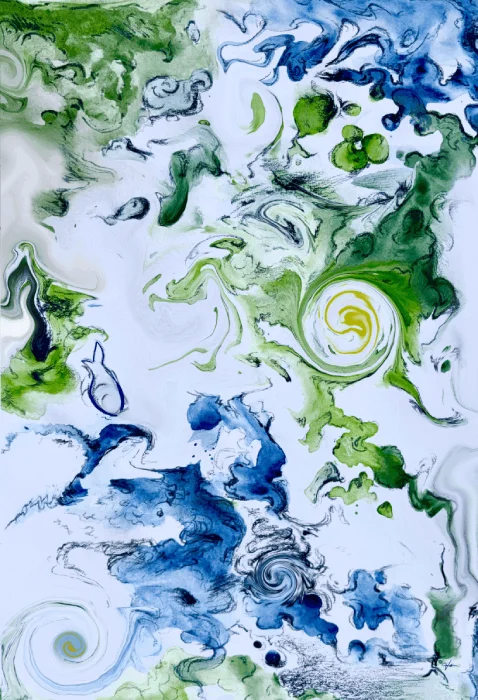
finished drawing a blue fish
in the margin of her workbook.
The fish remained unfinished.
Its eye was missing.
Window glass crossed the playground
faster than the swallows lifting from the roof.
A desk landed upside down
in the branches of a pomegranate tree,
and one page of arithmetic remained there for months,
fluttering whenever the wind shifted direction.
Children pointed toward it from the road.
No one climbed high enough to bring it down.
Later, men measured the crater.
They recorded depth, radius, displacement,
carefully filling columns with numbers
that could survive filing cabinets and decades.
They recorded everything except
the sentence abandoned halfway
through its final word.
The bomb prefers numbers.
The notebook recovered from the rubble
preferred horses, clouds, and blue fish.
A name appeared twelve times
on the inside cover,
scratched out,
then written again in darker pencil.
Spring entered the crater first.
Not hope.
Not healing.
Simply spring.
Mosquito larvae stitched black commas
across the standing water.
Dragonflies skimmed the surface,
their shadows arriving first.
A photographer crouched at the edge,
framing reflection instead of depth.
Years later, the photograph hangs crooked
in a municipal hallway.
Nobody notices the crater.
Everyone notices the reflection.
Twenty-seven years later,
a shepherd still points with his staff
toward a patch of ground most maps ignore.
Not there, he says.
Here.
As though memory were livestock
inclined to wander beyond the fence.
In a workshop,
a man sands a prosthetic ankle
until it shines like wet driftwood.
In another building,
a clerk lifts fragments
from acid-free boxes
and records their weight.
Elsewhere,
a cartographer redraws a boundary
that has already moved twice.
After heavy rain,
a rusted fragment surfaces near a drainage ditch.
Its edge resembles a leaf.
A child slips it into her pocket
and carries it home among marbles,
receipts, and a broken key.
That evening, her mother removes it
with kitchen tongs and places it
on the windowsill beside a bowl of coriander.
For several days,
both objects dry
in the same sunlight.
At the museum,
the bomb rests beneath glass.
Visitors move slowly around it,
reading dates,
names,
distances,
their lips moving silently
over places they have never seen.
One afternoon, a girl presses her palm
against the display case.
Then she opens her notebook.
She draws a fish.
This time, she begins with the eye.
Outside, beside the loading dock,
coriander pushes through a crack in the concrete.
No one planted it there.
No one remembers how it arrived.
The guard locks the doors.
The museum darkens.
Beneath asphalt,
beneath roots,
beneath decades of careful measurements,
a coriander seed
breaks itself open.
The guard asked whether she carried
anything alive.
Decades later,
the answer arrives leaf-first.
Appeared in Issue Fall '26
Comments on "The Bomb Calls Itself a Gardener"
Please log in to submit a comment.
Login