
Published April 27th, 2026
Interview
Objects as Horological Device — An Interview with O Jungio
by Anushree Nande
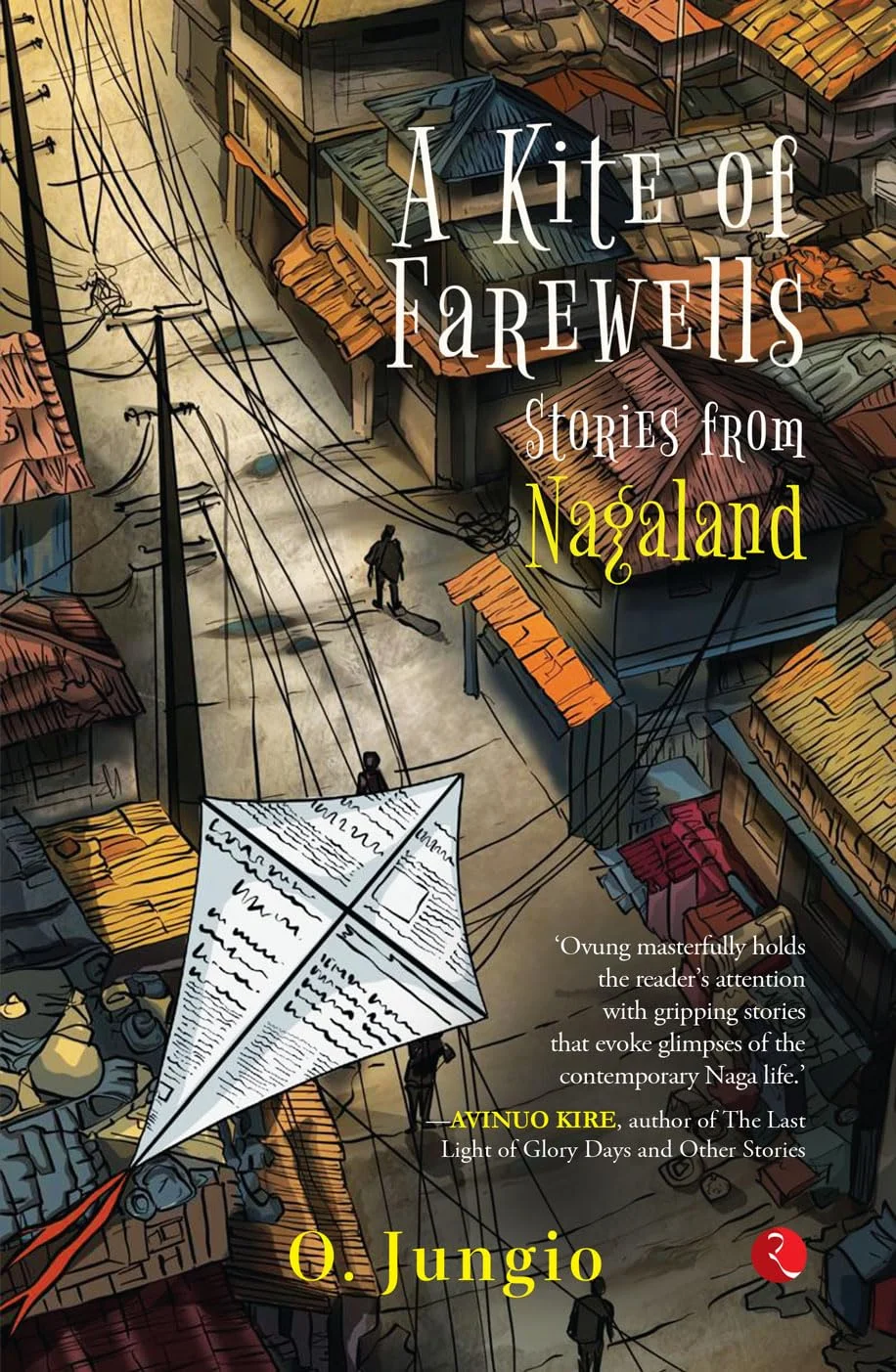
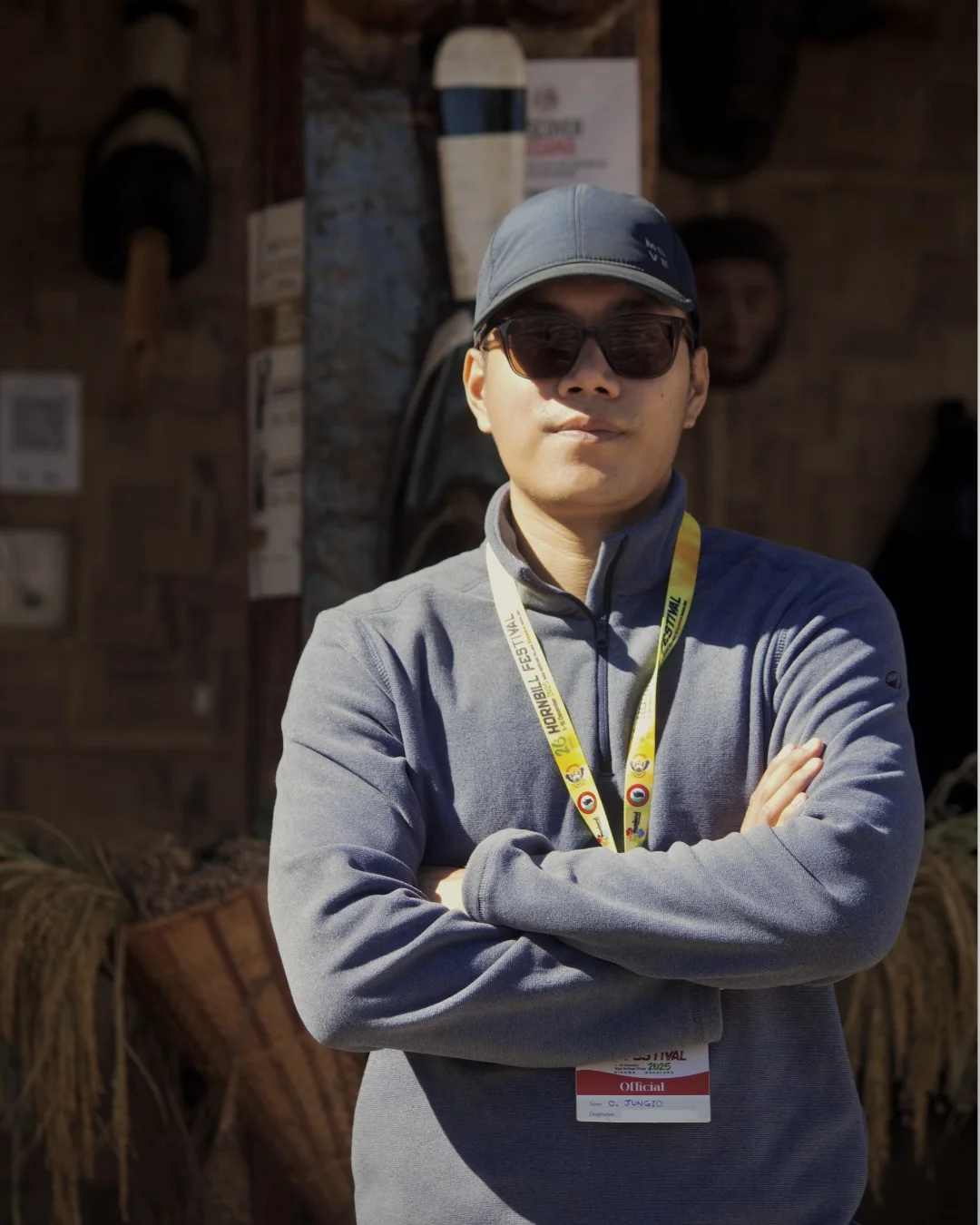
O Jungio is a Nagaland-based writer and the author of Kalopsia (Penthrill, 2019) and A Kite of Farewells (Rupa Publications India, 2025). A cultural researcher at heart, he finds inspiration in the indigenous food and music of Northeast India. When he isn’t writing, he serves as an assistant research officer for the Government of Nagaland. Through both his creative work and official research, O Jungio remains dedicated to exploring and documenting the rich tapestry of Naga and Northeastern life.
***
I came across his debut short story collection on Instagram a few months ago, read some excerpts, and reached out to express an interest in interviewing him about it. A Kite of Farewells was my first foray into writing from Nagaland, and the collection has whetted my appetite for more. O Jungio has a distinct narrative style that intersects with the stories’ themes of identity, preserving the old while also embracing the new, migration, community, grief, longing, and loss. This is storytelling that feels at once fresh and nostalgic, whimsical and surreal, but also tender, thoughtful, sincere, and nuanced. Here is an edited version of our conversation.
Anushree Nande: Each story in A Kite of Farewells has a central object. Object as memory, as connection, as a tangible representation of emotion, time, place, a person, of who you were or are. Can you elaborate on said theme and concept?
Ovungthung Jungio: Paraphrasing the preface of the book: “Each story within these pages is tethered to an object that bears silent witness to the lives that once brushed against its form… The objects — mute spectators to human sorrow — become the vessels of collective grief, the repositories of the most intimate of farewells.” A dead watch, a tattered kite, or a hand-drawn scorecard is singularly commonplace in a vacuum. However, when viewed through the lens of loss or longing, that same object becomes sacred. It acts as a tangible bridge to a version of us that no longer exists, or to a person who has long since departed.
In this collection, the theme explores the object as a horological device, something that marks a specific time and place with more accuracy than a calendar. By focusing each narrative on a central item, I wanted to explore how material culture serves as an anchor for the soul. The objects do not merely represent memory; they embody it. They allow the characters, and by extension the readers, to touch the intangible. This concept allows for an exploration of Naga life (a life of myths, beliefs and customs) that is both deeply personal and universally recognisable — everyone has, at some point, held an object and felt the weight of a world that is no longer there.
Anushree: How did you choose the objects?
O Jungio: My fascination with objects stems from the quiet spaces left behind by loved ones — the echoes of memory that linger after they pass on. I’m drawn to things like the empty chair at a dining table, once occupied by a father noisily munching his meal with his head buried in the newspaper. Informed by these observations, the stories felt as though they had always existed; my task was simply to tether them to a meaningful narrative. For most of these tales, the object arrived first. I curated an extensive list of associations drawn from the items dotting my home and the world beyond, letting them guide the narratives.
Anushree: Your epitaph is a quote by Rainer Maria Rilke: “Let everything happen to you. Beauty and terror. Just keep going. No feeling is final.” How does it tie into the stories and the collection as a whole?
O Jungio: I first encountered that quote during the end credits of Jojo Rabbit, where it was aptly framed by the renewed optimism of the protagonists: a boy who had just lost his mother and a girl finally liberated into freedom. It captured the start of a new chapter in their lives, one born from the ruins of the old. The stories in my book, although marked by death and loss, similarly signal the hope found in the beginnings that often follow such endings.
Anushree: Your preface calls this an “anthology of departure.” Can you discuss the symbolism of the title, A Kite of Farewells?
O Jungio: The act of letting go, much like releasing a kite into the wind, can be simultaneously sorrowful and liberating. It acknowledges the past, accepts the present, and allows for the possibility of what is yet to come. Throughout these stories, the kite serves as a recurring motif: a reminder of the ephemeral nature of moments, the weight of what has been lost, and the courageous act of untangling ourselves to embrace the uncertain winds of the future.
Anushree: All stories in the collection seem to embody the juxtaposition of changing times against that of the understandable intense sense of nostalgia. Can you talk about this decision?
O Jungio: I grew up during a period of significant transition and was fortunate enough to observe these changes from a close vantage point. Wokha, my childhood home, is a quiet town where weeks often bleed into one another without a single memorable event to distinguish them. In the face of such a tranquil existence, the primary markers of the changing times were material cultural imports, such as pop culture magazines and new technology. This lingering sense of nostalgia is explored throughout these stories. It finds its perfect homage in “Code Blue,” a story intended to recapture the inflated optimism of Y2K-era Wokha through a rose-tinted lens.
Anushree: We are all products of so many varied things. According to you, how has your journey so far impacted your storytelling?
O Jungio: I concur. My writings cannot, and should not, be viewed in isolation from the many experiences that have shaped me, the culture that has informed my values and aesthetics, and a childhood spent chasing stories. My love for the craft of storytelling began at home, growing up with my brothers in a house that felt increasingly small for our magnificent imaginations. We would barter stories of the kooky variety, constantly trying to outdo one another in absurdity. I also grew up in a mixed neighbourhood, which gave me ample opportunity to absorb the lived realities and quirks of the varied people who would frequent our living room, often with food in hand.
As a lower-middle-class neighbourhood where most were beginning their journeys as young families, it exposed me to the hardships that such circumstances often entail. An avid observer myself (I was told as a child that I was precocious in this regard), I studied and internalised the unspoken realities of Naga society. Contrary to popular theory, Naga society is usually classist rather than egalitarian. These observations have informed all my writings.
Anushree: At a time when more literature from Nagaland is finding its way into the mainstream, how do you approach juggling both personal and wider (faithful) cultural representation, even as you focus on the stories you want to tell?
O Jungio: I asked myself this question countless times whilst editing the manuscript. I found some solace when I was informed, albeit rather late, that most writers from the periphery of the mainstream (specifically those from Northeast India) wrestle with this conundrum as a rite of passage. The consensus generally favours cultural fidelity over mainstream appeal. I would be lying, however, if I said I had not considered toning down certain “esoteric” elements of the cultural map within which these stories operate. Ultimately, I am glad I resisted that impulse as the stories steeped in specific cultural references (many of which may be unfamiliar to mainstream readers) are the very ones that found the greatest resonance with readers from outside Nagaland.
Anushree: In continuation of the above discussion, how has your job at the Department of Art & Culture for the Government of Nagaland aided in shaping the perspective you bring to your work, if at all?
O Jungio: As an assistant research officer, my work primarily involves the research and documentation of tangible and intangible Naga culture. It requires frequent field visits and extensive interaction with elders, cultural custodians, and experts, all of which integrate seamlessly into the research phase of my creative writing. Indeed, there have been numerous instances where my prose was elevated by the insights gained during these interactions. Another significant advantage is the access this role provides to the resources managed by the department. Since the department oversees both the State Museum and the State Archives, I am fortunate to work within a wealth of historical and cultural material that is readily at my disposal.
Anushree: These are quiet stories of “normal” (for want of a better word) people, infused with magic realism, local folklore, and myth. What motivates or draws you to write and tell the stories that you do?
O Jungio: Daily life for a Naga person is defined by contradiction. On one side is the material comfort of modern living, which brings with it scientific thinking and rationality; on the other is a persistent reverence for certain beliefs and customs which might be mistaken for mere superstition. A further facet of this existence is that these seemingly incompatible contradictions coexist and even complement one another.
On a personal note, the colony where I live, a disparate scatter of concrete buildings, sits beneath the mythical Mount Tiyi. This peak is believed to be the abode of the dead, known as Echü Li in the Lotha language. I remember being sternly reminded by an elder to “call my spirits back” when I ventured up there for a trek. Given these surroundings, it felt only natural to weave this reality into the narratives of my stories.
For my readers, particularly those from outside the Northeast, I realise I may appear to be perpetuating stereotypes by leaning into the mystical side of folklore. However, if one looks deeper, they will find that at the heart of such stories lies a profound capacity for compassion and a celebration of differences, qualities that this country is in dire need of lately.
Comments on "Objects as Horological Device — An Interview with O Jungio"
Please log in to submit a comment.
Login