
Essay
The Morozov Mansion
by Natasha Lvovich
Dyrka[1]
We lived, all eight of us, together with the grandparents and my aunt Ilia’s family, in the apartment on Podsosensky Street in the former servants’ quarters of the Morozov Mansion, with two Atlases holding a balcony. The servants’ quarters had been converted into a dormitory during my grandfather’s glamorous Bolshevik past as a college president, and the mansion was his kingdom. Then it became the publishing house Nauka (Science) and the dormitory a residential building. We had to keep it a secret that we had an apartment all for ourselves, which was unheard of, since everybody lived in communal apartments with strangers.
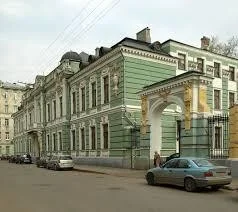
The main entrance into the former Morozov compound was through the huge iron gates in Podsosensky street, wide open and grown into the asphalt; to enter the servants’ quarters where we lived, one had to get to the spooky back door, chorniy khod, around the corner. There was a yard there, where we were let out to play by ourselves, while Baba Mina watched us from the tall living room windows. The yard was surrounded by a fence — but nobody knew where that fence ended or what was behind it.
Children were not allowed beyond that fence, and adults were not allowed either, but they did not comply and broke the rule (and the fence) by stepping into the forbidden territory through the ubiquitous dyrka, which provided a shortcut to Kurski metro station and saved about ten minutes of walk. My parents and neighbors who were privy to the secret acted like shady characters in spy movies: men in hats and long wool coats, carrying briefcases, and women on high heels, with elegant pocketbooks, approached the fence, furtively looked around, then moved a board aside, and stepped to the other side, as elegantly as they could, trying to keep their balance and not to ruin their stockings and hats. Then, when safely there, they would straighten their suits, adjust their hats, stamp their feet, and put the board back into place, pretending that they had never breached the threshold.
From time to time the hole got patched up by some mysterious forces and the fence board hammered firmly into place. Then I would hear some elliptical whispers in the kitchen: “…Ty slyshala? Dyrku zakryli…” (Have you heard? The hole has been shut off), but the following day it would magically reopen. The hole was one of those omnipresent things in life, like breathing, walking, and speaking the native language.
Once I mustered some courage and peeked through the hole. I saw a gloomy nameless building and an overgrown unkept garden, more like a yard, with nurses in white coats walking back and forth, sometimes holding some faceless figures wearing drab grey flannel robes. There was no name, no sign, and no number on the building.
Chicks from Ilia’s Lab
Once Ilia brought home tiny yellow chicks for me and Nina to play with. Babushka put them in a bathtub where they ran like mad, chirping peep-peep-peep… We took turns holding the fluffy cute chicks in our hands. I guess Ilia wanted us city kids to experience and touch animals. The following day she took them back to the lab.
Ilia was a micro-biologist, who had studied at the university during Lysenkovschina [2] when Stalin declared Mendelian genetics the “capitalist science” — “prodazhnaya devka imperializma” (imperialism’s whore). She studied genetics in secret, from the books brought to her by her boss. Her boss was a brilliant scientist and a larger-than-life figure. His last name was Kushner, which is what she and all of us called him. The omnipresent Kushner lived not only in Ilia’s lab, but in our house on Podsosenski, sitting with us in our windowless kitchen and sleeping in Ilia and Mark’s bed. He called the women in the lab his “girls” (devochki), regardless of their rank or position, whether they were technicians, researchers, or published authors like Ilia. He was like a mother hen, and they were his chicks who needed protecting.
I have never been to Ilia’s lab, but I called her there quite often (it was common to make personal calls to people’s workplaces). I imagined the phone hanging on the wall, like in a large communal apartment, and the “girls” in white coats walking back and forth in a dark hallway smelling of chickens, who were clucking sweetly in their cages. I did not feel shy to call Ilia’s lab, and I was at ease with her colleagues, like her college friend Tyotia Lena, whose family we knew. Perhaps in my mind, the lab emulated her friendliness, simplicity, and camaraderie. I would call and say, “Allo! Can I speak to Ilina Yefimovna please?” (one had to use the name with the patronymic), and whoever passed by and picked up the phone would yell, “Ilia, Ilia! Pick up the phoooooone!” Just like that.
Sofia Moiyseevna
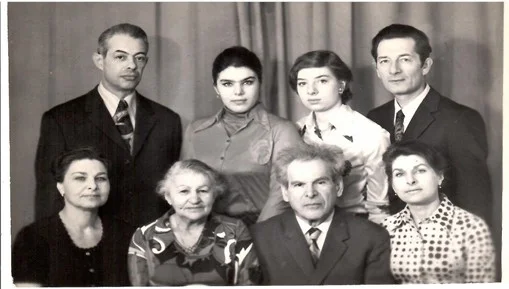
I have no idea how Dedushka and Babushka met Sofia Moiyseevna. She lived in the neighborhood and was a widow; her husband was an old Bolshevik and was shot during Stalin’s purges, and her son went missing (propal bez vesti) in the war; she herself otsidela (did time) in the gulags in the 1930s. That was when they took wives too. “Ochen’ khoroshaya zhenschina…” (a very good woman), my grandfather would say with a sigh, but I felt he really meant something else.
She was a big woman in her seventies with a mustache and a deep voice, and she sported a winter coat with the fox’s head hanging on her bosom. The fox looked miniscule and pathetic on Sofia Moiyseevna, who had the stature of a general. On the top of her head, she wore an incongruous old-fashioned little hat, which was sitting askew, with a woolen Orenburg lace shawl wrapped around it.
Sofia Moiyseevna was on my grandfather’s “matzo list.” Every Passover, Ded Yefim would make a ritualistic trip to the Moscow synagogue, the only one in the city, with one and only rabbi, who was known to be a KGB agent. It was the only place where matzo was baked, and Dedushka purchased several kilos. He would return home with several packs of matzo, wrapped in brown paper and tied with a rope. Then, within the next few days, he took it upon himself to distribute it among family and friends, traveling all over Moscow. It had to be done discreetly because it was dangerous to be Jewish, to celebrate Passover (even on May First, the Day of Solidarity of Workers), to eat matzo, to speak Yiddish, and to learn (or teach) Hebrew.
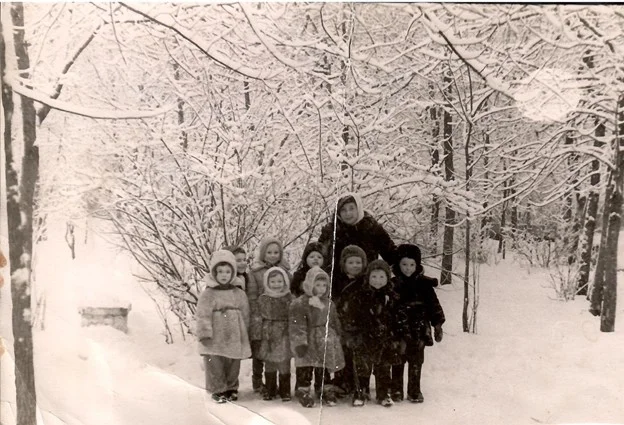
Like Jewishness, private enterprise was not condoned in Soviet Russia, but Sofia Moyiseevna took a chance and made a few extra rubles to complement her meager pension by taking a few neighborhood kids to a local park for a couple of hours, to give them (and their families) a breath of fresh air. She would pick us up, me and Nina, and then three or four other kids, on our way to Milyutinskiy sadik (Milyutin park) next to Annushka tram stop (tram A). In the summer, the park looked like a wild jungle, with lush tall grass, overgrown bushes, and tall trees around a couple of alleys, with a few broken benches and a dry fountain with a thirsty disfigured cherub. This is where Sofia Moyiseevna usually gathered us. It was fun to play hide-and-seek there or to make secretiki (little secrets). In the winter, snow piled up and was never cleaned, so it was heaven for sled rides and snowball fights. Sofia Moyiseevna stood at the fountain, the gathering place, stamping her feet in proschay molodost’ boots,[3] wiping our noses before handing us back to our families. We dragged our sleds with an awful screeching noise on icy sidewalks patched with handfuls of sand. At home, Baba Mina hung my hat, scarf, mittens, and coat above the bathtub to dry. They dripped for hours.
Flower Looting
Occasionally we, all eight of us, Babushka, Dedushka, Ilia, Mark, Nina, my parents and I, were invited for dinner by my grandfather’s sister Tyotia Rosa, who lived near VDNKH[4]. At the table, the grownups discussed the grocery items that they managed to get standing in lines or as part of holiday “orders” (zakazy) at their workplaces. Then the grandparents and Tyotia Rosa reminisced about Shumilino, the shtetl, their cow, and the vegetable garden. Yom Kippur, which meant nothing to me, was their next subject, discussed along with stories about their cousins and relatives, Shmuel, Khezia, Bertha, Lazar. I was always confused about who was who and ashamed of the sound of these names. Then Tyotia Rosa talked about her time as a young Communist at Comintern[5].
My ears shriveled of boredom, as the Russian idiom goes. There were three of us kids: Mishka, Tyotia Rosa’s grandson; Nina, my sister-cousin (dvoyurodnaya sestra); and I. I was the oldest. Like most Moscow buildings, Tyotia Rosa’s building had an inner yard, with a nice lawn and flower beds. We were allowed to go outside and play. First, we made swords out of sticks and played musketeers, D’Artagnan and Aramis (me and Mishka) engaged in a duel. Then we decided to make a kite out of a piece of paper and a rope, and I put Mishka and Nina in charge of “wind making” by running back and forth, but it did not fly (literally) and the “wind makers” rebelled.
Then I came up with a new game: it seemed like it would be a lot of fun to pick a few tulips and daisies from the lawn, maybe just two or three, and bring them upstairs, hiding them under our shirts. Adrenalin rushing, we ripped a few flowers from the flower bed. But then something odd happened: we were suddenly and collectively swept by some manic fever, and without exchanging a word or a wink, we ripped all the flowers we could reach, pressing the fragrant booty to our faces, inhaling, and moaning of pleasure and exhilaration. We hid bunches of flowers under our shirts and, holding our protruding bellies, climbed the stairs to the fourth floor, heading straight to Tyotia Rosa’s bedroom to hide, like thieves.
A few minutes later, the doorbell rang — two policemen were at the door, wearing huge caps with a red stripe and a cockade. It must have been quite a shock to the family still dining at the table, who had been traumatized enough by unexpected visits of uniforms. A neighbor had spied on us from her window and called the police. We had to confess our crime, but we could not explain it. The cops and the fuming parents followed us to the bedroom, where a fragrant pile of flowers lay on the floor. The grownups apologized to the cops and promised that we would be duly punished.
I refused to visit Tyotia Rosa again.
Skiing Escapades
In the winter, when minus temperatures got steady and the snow solidly stayed on the ground, errands and chores were put aside on Sundays, and three of us, Papa, Mama, and I, went skiing to Izmaylovo park. It was an easy ride by metro. Like many families, we did cross-country skiing regularly and had our own skis and gear: light bamboo sticks and ski boots with binding. We bundled up in layers of sweaters and jackets and put on our woolen hats and water-resistant mittens. The ski wax, in tubes like lipstick, had to be applied to the skis to maximize sliding, and it was important to apply the correct one based on temperature. Papa oversaw all that science: the thermometer, the weather, the snow, the wax. He had designed a special tall compartment in the hallway closet for skis and ski gear. The skis were clipped together with a ski clip, and a special wooden piece was inserted between them right in the middle to keep them bouncy. The closet, the gear, the wax, and the mittens made us take skiing seriously.
Mama had a forest green ski suit and a black fluffy hat, which made her head look like an egg because of her bun. She carried a backpack with everything we needed on the trip: a water bottle, handkerchiefs, napkins, the transportation money, and some tangerines to snack on. At some point, we would stop at a meadow for a tangerine break (mandariny in Russian), our cheeks burning from cold air, with the gloves hanging on elastics from our sleeves. Our fingers were red and stiff, as we peeled the tangerines and opened them into fragrant slices, their perfume bursting in the winter cold air. Then we would form again our threesome goose line on the ski trek.
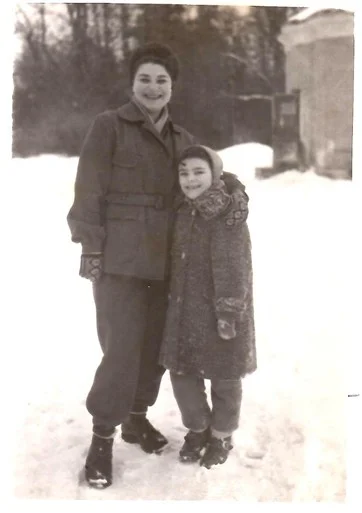
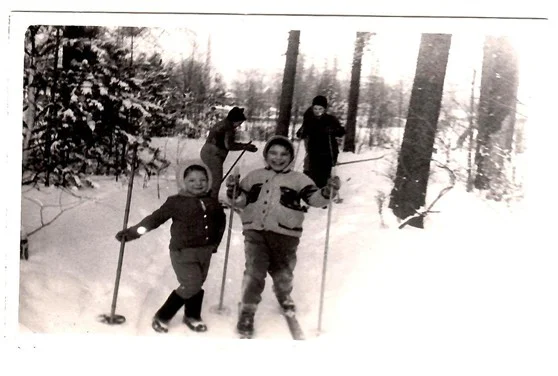
Papa usually made me follow him, to learn his skiing technique — a series of small steps in between big leaps, as if preparing to take off and launch forward with force, leaning on the sticks and throwing them far back. A trail down the hill was a special treat: Papa taught me to bend my knees, stick my butt back, squeeze the sticks in my armpits behind me, and glide down with the wind.
Moscow winter sky would darken early, and by three or four in the afternoon we had to find our way to the metro station. The endorphins of well-being kicked in on the ride home; I struggled not to doze off on the train. Our sweaters and scarves were covered by tiny icicles, hanging like poorly sewn beads. These sweaters would be hung to dry over the bathtub.
It got pitch dark outside, when we finally reached home and disembarked with our heavy gear, then changed into dry clothes. I usually helped Mama to peel potatoes, and the kitchen would quickly fill with the aroma of fries, our traditional after-ski meal. Then Papa would watch some hockey or an old movie on TV. He liked to sit at the living room table, smoking a cigarette, often with a cup of strong tea, and I would tiptoe to him from the back and hug him around the neck, trying to hold on to the smell of winter woods, of tangerines, snow, and of warm cozy happiness.
Rainbow Dresses
Every morning on the way to school, Baba Yulia and I counted “rainbow dresses” that every other woman in Moscow seemed to wear that season, like a uniform. Apparently, the cheerful cotton fabric with rainbow design was on sale in all department stores, and many Moscow women had their summer dresses made of it.
When we moved out of my grandparents’ house on Podsosenski street, I had to commute every day to my French-specialized school (spets-shkola) by metro. It was Baba Yulia’s job to take me to school and to pick me up, until I was able to take the metro by myself. On the way to school, she kept me busy with various useful mental activities, such as counting rainbow dresses, reviewing the multiplication table (nine times four? five times eight?), or reciting poems and prose assigned to be learned by heart:
Мой дядя самых честных правил,
Когда не в шутку занемог,
Он уважать себя заставил
И лучше выдумать не мог…[6]
Or:
“Чуден Днепр при тихой погоде, когда вольно и плавно мчит он через леса и горы полные воды свои. Ни зашелохнет; ни прогремит.”[7]
Or:
“Vienne la nuit sonne l'heure
Les jours s'en vont je demeure”[8]
The Magic Pot
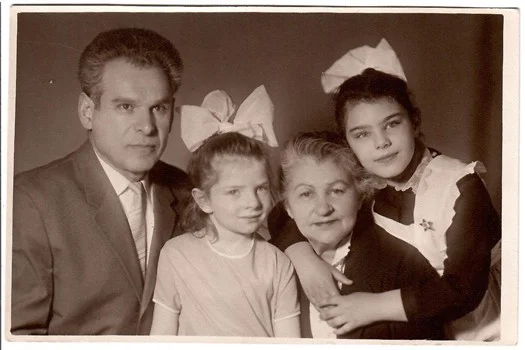
Nina and I spent summers with our grandparents at the Pansionat Klyazma, the Soviet version of Club Med for families and our family’s alternative to a traditional dacha (country house). Dedushka, the family patriarch, often lamented about his dacha-less existence (dachas were distributed by the government): he had miraculously dodged gulags but had to leave his Soviet throne early in the game. We liked Klyazma, although we often complained about the mandatory meal plan at the stolovka (cafeteria). It felt pretty much like home, with all four of us staying in one tiny room, sleeping, fighting, performing morning ablutions, and occasionally cooking and eating. Bathrooms and showers were in the hallway.
Baba Mina was a survivor. She told us that during the war, she made pancakes out of potato peels, kasha out of the grain found at the bottom of a bag, and vegetable stews out of scrapings. At Klyazma, she recreated the touch of home by making vegetable soup (schi) using the portable electric boiler (kipyatilnik). Normally, this Soviet device was used to boil water for tea or for (instant) coffee while camping or in various life disruptions, which were not lacking. With typical ingenuity and a few veggies, Baba Mina converted a mug with kipyatilnik into a magic pot, right on our night table. Our small room filled with wonderful homey vegetable aroma, which spread at once in the hallway. Baba Mina told us to lock the door, so that pansionat security would not barge in and catch us in flagrante delicto, since using kipyatilnik in the room was strictly forbidden. She stirred and waved the spoon like a magic wand and murmured the spell, Varis’ supchik, varis… (Cook, my soup, cook…). It was indeed a delicious soup.
Camping with Babushka
We were bored by regular summer activities, by being shepherded on the river shore, by swimming and playing volleyball and badminton, or biking around the reservoir, or chasing after older kids and playing cards in the lobby. We begged Baba Mina to take us camping in the woods, where we would make a campfire and bake potatoes. It was every kid’s ritualistic dream: to sit around a campfire with friends, sing Bulat Okudjava and Vladimir Vysotskyi, eat tushonka (canned beef), and bake potatoes on the campfire. Deep down, we knew of course that camping with Babushka a few hundred meters away from the crowded pansionat was not the real thing but a make-belief, like playing dochki-materi (literally “daughters and mothers,” a game of family), but an illusion was better than nothing. We whined, sulked, and made sour faces: Ba-a-a…Nu Ba-a-a…Nu poshli v pokhod… (Grandma, let’s go camping). She rolled her eyes. She sighed. She muttered “Meshuggah” (“crazy” in Yiddish) under her breath. But finally, she conceded: Nu khorosho, zavtra. (OK, tomorrow).
We took off in the early evening, taking the familiar path among pine trees, thick ferns and shrubs, then we reached a meadow on the river shore, which veered onto a place with huge tree roots forming steps down the hill. The river glistened through tree trunks; a few boats rowed; some drunken singing resonated from there, invariably about quiet Moscow nights.[9] We walked a little deeper into the woods, and when we found a cozy clearing, a nice spot for a campfire, it was already dark.
Baba Mina sent us to pick firewood, of which there was plenty on the ground; we spotted a knocked down dead tree whose leafless branches could be torn off. She pulled out of her bag a box of matches (sometimes she smoked, in secret) and a newspaper, to start the fire. We sat and watched it, mesmerized. Sparks flew and spiraled up in the dark sky, blending with stars.
Then Babushka pulled out of her bottomless bag a few potatoes. To bake them, we had to wait until the fire burned out to embers and ashes, where potatoes were buried. We cleaned and sharpened a couple of sticks with Baba Mina’s kitchen knife, to poke the potatoes for readiness. When the potatoes got soft inside and the sticks could pierce them, we pulled them out. They were so hot we couldn’t hold them in our hands. When we cracked them open, there was a layer of brown crust underneath the blackened skin — and inside, the delicious white softness. Baba Mina did not forget the salt… Nothing was tastier than this. Baba Mina laughed, wiping our black mouths and chins. We were happy.
Dried Apples and Family Bedsheets
Grocery stores in Moscow were literally empty, but in my aunt Ilia’s neighborhood there was a vegetable store which sometimes offered surprises. One had to go “hunting” every single day in case something yummy fell from the sky. In the summer, for example, Hungarian tomatoes or eggplants from Astrakhan would magically appear in that store — and we would stand in a long line and buy five kilos, which we would share with our two families and the grandparents, meeting up and passing on huge grocery bags on metro platforms or at correspondence stations under the ubiquitous clock (pod chasami). The following day the store would be empty again, and in the winter, if we were lucky, raisins and dried apples were the only trophy.
Ilia almost always had some dried apples at home, soft and sweet wrinkled apple circles, and we liked to snack on them. I would sit on her couch, with a bowl of those dried apples, my fingers sticky, throwing the circles in my mouth, leaning on a pile of striped bedsheets made of imported Indian cotton, already prepared for my overnight stay. Mama had “obtained” those sheets for herself, Ilia, and Babushka, so no matter where I stayed, I slept on the same sheets. The mantra was that these sheets were so sturdy they would last forever.
Here is the picture of Ilia’s living room in my mind, year after year, decade after decade: the beige velvet couch, a bowl of dried apple circles, and the striped pastel color “family sheets” imported from India. I am a kid, a youngster, a teenager, a college student, a married woman… I am licking my fingers, sweet and sticky from dried apples and I am inhaling the fresh scent of the sheets.
[1] Dyrka means “hole” in Russian.
[2] Lysenkovshina (Lysenkoism) is the pseudo-scientific ideology in Soviet Russia, originated by Trofim Lysenko, a Soviet agronomist and director of the Institute of Genetics (1940), who suppressed Mendelian genetics and science-based agriculture.
[3] Proschai molodost literally means “goodbye youth,” the name given to old-fashioned felt winter boots with a zipper in the middle, mostly worn by older women.
[4] VDNKH-ВДНХ–Выставка Достижений Народного Хозяйства, Exhibition of Achievements of the National Economy.
[5] Comintern — The Communist International, an international organization designed to advocate for world Communism, founded in 1919 and controlled by the Soviet Union. All committee members and staff were eventually purged by Stalin.
[6] Opening stanza from Eugene Onegin by Alexandre Pushkin:
My uncle, man of firm convictions...
By falling gravely ill, he's won
A due respect for his affliction—
The only clever thing he's done (trans. by James Falen).
[7] The famous line from Nikolai Gogol’s prose: “Wondrous is the Dnieper in calm weather, when freely and smoothly he races his full waters through forests and hills. No rippling, no roaring.” (trans. by Pevear & Volkhonsky)
[8] The refrain from a poem by Guillaume Appolinaire from Pont Mirabeau:
Let night come on bells end the day
The days go by me still I stay (transl. by Richard Wilbur)
[9] This refers to a popular song “Подмосковные вечера” (“Moscow Nights”).
Appeared in Issue Fall '26
Comments on "The Morozov Mansion"
Please log in to submit a comment.
Login