
Essay
Algorithmic Womanhood
by Paulina Jarantewicz
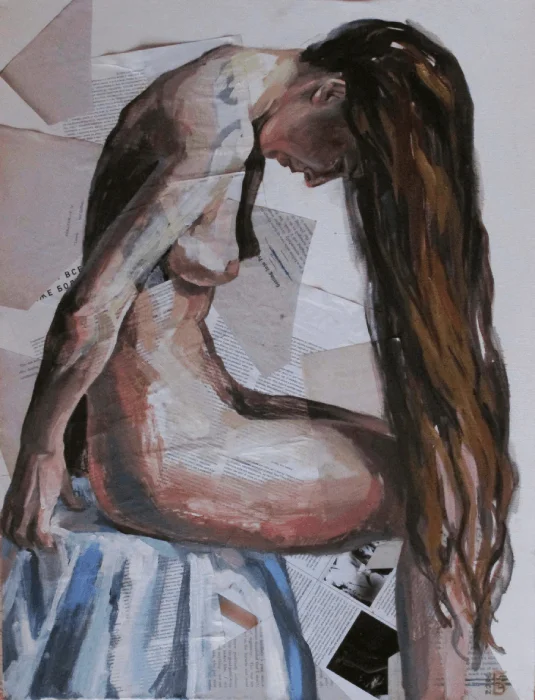
I don’t remember when I stopped looking at my body and started auditing it. It happens at 6 a. m. now, still in bed, before my eyes have fully opened. My thumb finds the app by muscle memory. Literally. I think some new evolution of human physiology where the pathway from brain to thumb to screen has become its own nervous system. The first video loads: a girl doing pilates in a sports bra. Twenty-something. Three million followers. When she bends forward, her stomach stays flat. Not a millimeter of flesh. She drinks celery juice from a mason jar, and I understand this is meant to be aspirational, but what I actually feel is something closer to religious. This is the body and blood of the impossibly disciplined.
I watch twelve more videos before my feet touch the floor.
By the time I reach the bathroom, I have already lost the morning. The mirror waits, and I know what I’m supposed to do. I lift my shirt. My fingers find the softness at my waist, that pinch of skin that refuses to be anything other than what it is: human, pliable, real. The lighting is terrible. Dull and yellow, creating shadows where I have been taught to want definition. I make a mental note to document my progress later, in better light. Natural light. The kind of light the girls in the videos always seem to exist in, as if they have made some pact with the sun itself.
This is the doctrine I have learned: Document the journey. Trust the process. Transformation is inevitable if you simply do all the steps correctly.
My phone’s screen time report appears at the bottom of the notification panel. 43 minutes. It’s 6:43 a. m.
The women I watch have turned wellness into theater. They make protein pancakes with performative joy, cracking eggs one-handed into aesthetic ceramic bowls. They line up glass containers on Sunday evenings. They say it’s meal prep, though what they’re really preparing is evidence of their own virtuousness. They drink full gallons of water, carrying around jugs that say things like “You Got This!” in curling script. They take “hot girl walks,” which are apparently different from regular walks by virtue of being filmed and captioned. They do that specific workout, the one that goes viral with clockwork regularity every three weeks. A different girl, the same motions. A different body. The same body.
I screenshot the workout routine. It joins 66 others in a folder on my phone I have titled “Start Monday.” I have completed perhaps three of these. Possibly four. The folder has become its own form of documentation. Not of what I’ve done, but of what I perpetually intend to do. A graveyard of unbecome selves.
At work, I drink black coffee and log it. 50 calories. The app tells me I have 1,150 remaining for the day. It used to be 1,400, but I adjusted it last month. The women in the videos live on 1,200 calories. Some on less. They don’t state this explicitly. That would perhaps be too honest, too liable. But the information transmits itself anyway, through portion sizes and plate compositions, through what is eaten and, more significantly, what is not. You learn to calculate by watching. You learn to decode the language of acceptable hunger.
Lunch is Greek yogurt and a handful of berries. I try to photograph it, thinking maybe today I will post, maybe today I will become the kind of person who casually shares their wellness journey. I delete the first attempt. The lighting is wrong. Try again. The bowl isn’t right, it’s chipped on one side and the berries look dull, insufficient. I eat my lunch without posting. There’s a saying I’ve internalized, though I can’t remember where I learned it: It doesn’t count if you don’t post it. A lie, obviously. It counts. My body knows it counts. The app confirms: 320 calories logged.
Around 2 p. m., a colleague brings donuts. She’s maybe 40, maybe older, the kind of woman who exists outside the grid of constant self-surveillance. She sets the box in the break room with genuine enthusiasm. I refuse with a reflexive lie about having already eaten. She smiles, says something kind, leaves the box. The donuts remain on the counter all afternoon. I can smell them every time I refill my water bottle. Which is often, because the girls in the videos say you should drink water when you want to eat.
I open the app. Scroll. A girl is showing “what I eat in a day.” Egg whites for breakfast. Steamed chicken breast for lunch. Raw vegetables for dinner. Everything weighed on a stainless steel food scale that catches the light just so. The girl has visible abs. The video has 2.3 million views. The top comment: “I wish I had your discipline.” Discipline. That word follows me everywhere now.
At home, I do 40 minutes of pilates. The video is 20 minutes long, so I do it twice to be certain, to exceed, to prove something to no one but the surveillance system of my own mind. A dull ache begins to bloom at the base of my spine. The instructor on screen says to “engage your core,” but I can’t tell if I’m doing it right. She performs the movements with an infuriating, fluid ease, as if her body is simply agreeing with her intentions. My body feels like a negotiation I’m losing.
Dinner is salmon and broccoli. I photograph the plate. It looks, I think, like health, like virtue. I post it. Four minutes later, I check: 20 likes. I delete it. For reference, I investigate the posts of other girls. Their similar plates of salmon and broccoli garner hundreds of likes. Thousands. Comment sections full of “body goals” and “inspiration” and questions about their diets, their routines, their secrets.
I wonder what I’m doing wrong, even in performing the performance.
By 9 p. m., I’m back on the app. A new girl is trending. Her morning routine video has gone viral: she wakes at 5 a. m., drinks lemon water, does yoga on a balcony I’m certain overlooks something European. She makes a smoothie in a high-speed blender. Goes to the gym. Takes a shower filmed through aesthetic steam. Does an eleven-step skincare routine. The entire production is compressed into 90 seconds. She is flawless in every frame, and I know that this is the result of editing, of curation, of deliberate construction, but knowing this does not make me immune.
In bed, I scroll. The algorithm knows me perfectly. It serves only fitness content now, wellness content, the pervasive genre of body checks. Girls in high-waisted leggings executing slow rotations for the camera. Girls showing their stomachs while seated to prove there are no rolls. Girls showing their stomachs while standing. Look, no bloat. Look, this is after eating. Look, this is what real looks like.
But it doesn’t look real. None of it looks real. It looks like a shared delusion we’ve all agreed to call reality.
I set an alarm for 5 a. m. Tomorrow, I will start. Really start. I will be disciplined. Consistent. I will trust the process. I will become the kind of person who posts their breakfast and means it.
The app asks if I’m still watching. I tap yes. One more video. Just one. The girl is 20 years old. She’s drinking green juice. She has the body I want — or rather, the body I have been taught to want, the body I believe would make me happier, more lovable, more deserving of the space I take up in the world. The body I could have had, if only I wanted it badly enough. If only my will were made of something stronger than what I am.
My phone delivers its final report: 2 hours and sixteen minutes in the app today. This is less than yesterday. Progress, I think, and almost believe it.
I close the app. My thumb, operating on a level of consciousness beneath thought, opens it again immediately. The first video is a girl doing pilates in a sports bra. A different girl. A different video. The same video. The same body. She makes it look effortless. At the end, she promotes her workout guide. Twelve weeks to your dream body, testimonials in the comments, before-and-after photos that may or may not be the same person.
I click the link. The guide costs 40 dollars. I almost buy it. I close the browser. I already own six such guides, downloaded and unopened, their promises gathering digital dust beside those 67 screenshots.
Tomorrow, I tell myself. Tomorrow I’ll start. Tomorrow will be different. Tomorrow, somehow, my reflection will align with the ones on the screen.
I know this isn’t true.
The screen glows blue in the dark. The algorithm serves me another video. And another. And another. I know that I am both the watcher and the watched, both the consumer and the consumed. That I am participating in my own diminishment, scrolling myself into a shape that fits inside someone else’s monetized idea of acceptable.
I keep watching.
Appeared in Issue Spring '26
Comments on "Algorithmic Womanhood"
Please log in to submit a comment.
Login